Showing posts with label Utility. Show all posts

Saturday, March 23, 2013

Critical Role of Natural Gas in Meeting Electricity Demand with Intermittent Wind and Solar Resources

Natural gas is playing an increasingly critical role in keeping grids stabilized around the world with increasing penetration of intermittent wind and solar powered generation sources.  Even with the advantageous cycling available with natural gas power plants, however, many grid operators are implementing additional grid stabilization strategies including Power Curtailments, Negative Energy Pricing and Electricity Trading, in addition to available hydro pumped storage and run of river strategies.

In 2012, wind powered generation met thirty-five percent (35%) of the generation resources called upon in Denmark, and contributed a maximum forty-five percent (45%) in September.  From a capacity perspective, Denmark's wind turbines hit a capacity level greater than the country's peak requirement, 3.8 GW wind production versus 3.5 GW demand on March 11, 2013.  In order to meet the variable production dynamic associated with wind power, the Danish grid operators implemented a series of tactics, including wide swings in electricity trading, both imports and exports, as well as calling upon dynamic dispatching of natural gas generation resources.  The Denmark grid has six interconnection points with European grids, facilitating their trade in electricity, supporting both system stability objectives and economic objectives.


In Germany, several notable data points have been achieved with solar power and wind power.  On May 25, 2012, Germany hit a peak in solar generation capacity of 22.15 GW, producing 189.24 GWh on that day, contributing fourteen percent (14%) of the country's total electricity requirement.  Germany added 1,008 new turbines in 2012, connecting an additional 2,439 MW in new wind capacity to the grid.

From a recent report by the Fraunhofer Institute, solar power plants produced 27.9 TWh in 2012, reaching a 5% share of the gross electricity production of 560 TWh.  Wind turbines produced a total of 45.9 TWh in 2012, reaching an 8.2% share of the country's gross electricity production.  Accordingly, solar and wind production together 73.8 TWh, representing 13% of the country's total electricity production.

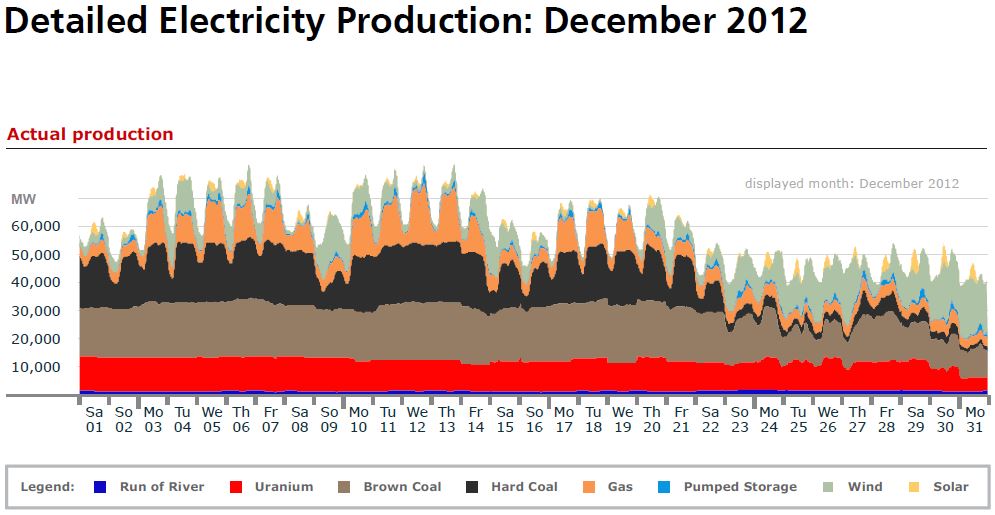
Also from the Fraunhofer report referenced above, the chart below provides details on Germany's electricity production for December, 2012.  One can observe in the chart the excessive variability in renewable energy resources, and the compensating for renewable intermittency by ramping both natural gas and hard coal generation resources, while essentially base-loading nuclear and soft coal resources.

It can be observed that natural gas is lower in the merit order loading for economic dispatch relative to coal and nuclear resources, and is called upon extensively to dynamically balance supply and demand.  


Thursday, March 14, 2013

Smart Grid Company Silver Spring Networks' NASDAQ IPO Raises $81 Million - Shares Surge 29% on First Day of Trading


Smart Grid Company Silver Spring Networks raises $81 million in long awaited IPO, with shares surging 29% on the first day of trading.  This IPO puts the company's valuation at approximately $750 million, and gives the company access to capital markets, an important source of capital to fund the company's operations going forward.  There are a few points to raise regarding this offering:

  1. The company sold 4.75 million shares, up from the 3.75 million shares it had expected to sell as of last week;
  2. None of the existing investors sold their shares in the IPO, preferring to hold onto their investments;
  3. The company has raised approximately $303 million in debt and equity since 2004;
  4. 2012 revenues of $197 million are 17% lower than 2011 revenues of $237;
  5. Silver Spring Networks lost close to $90 million in 2012, a number that has to get smaller very fast, or the company runs the risk of approaching subsequent capital raises just to fund negative margin operations; 
  6. The majority of the company's revenues come from 7 major United States utility customers; and
  7. The boom in smart meter deployments in the United States has subsided.

The basis for the company's valuation and future growth prospects is premised on the following:

  1. Leverage the Installed Base - Silver Spring Networks' deployed smart grid communications networks are platforms for deploying additional products and services up and down the energy value chain, from DSCADA to improve utility grid performance and operation, to leveraging the customer interface for utilities, and into the customer's premise, providing energy management control and data acquisition for customers.  Demand response, for example, represented a very small proportion of hte company's revenues;
  2. Expand Internationally - The opportunity for smart grid deployments and AMI continues to expand internationally, recognizing that Silver Spring Networks already has customer relationships in Australia, Brazil, the UK and Singapore.  International only accounted for an estimated 8% of revenues in 2012. 
  3. Deploy Additional Equipment and Services - Much like Itron, Silver Spring Networks has the opportunity to leverage its stock to acquire additional equipment and software companies to layer additional revenue generating services on top of their smart grid platform.
  4. Expand Into Additional Markets - Silver Spring Networks also has the opportunity to deploy their communications networks and solutions in gas and water industries, as well as selectively targeting other network and industrial businesses that can use their wide area energy management capabilities, perhaps including trains and natural gas pipelines.

At the end of the day, for this IPO to be successful, the Silver Spring Networks has to have a brilliant execution strategy over the next 12 months in order to demonstrate that they can meet the expectations embodied in this first day of trading.  Critical will be (1) turning around the decline in revenues; (2) reducing losses on a quarterly basis to demonstrate being on a pathway to a sustainable cash flow; (3) demonstrating success in expanding into new international markets; and (4) demonstrating their ability to expand products and services to leverage their core network platform.