Natural gas is playing an increasingly critical role in keeping grids stabilized around the world with increasing penetration of intermittent wind and solar powered generation sources. Even with the advantageous cycling available with natural gas power plants, however, many grid operators are implementing additional grid stabilization strategies including Power Curtailments, Negative Energy Pricing and Electricity Trading, in addition to available hydro pumped storage and run of river strategies.
In 2012, wind powered generation met thirty-five percent (35%) of the generation resources called upon in Denmark, and contributed a maximum forty-five percent (45%) in September. From a capacity perspective, Denmark's wind turbines hit a capacity level greater than the country's peak requirement, 3.8 GW wind production versus 3.5 GW demand on March 11, 2013. In order to meet the variable production dynamic associated with wind power, the Danish grid operators implemented a series of tactics, including wide swings in electricity trading, both imports and exports, as well as calling upon dynamic dispatching of natural gas generation resources. The Denmark grid has six interconnection points with European grids, facilitating their trade in electricity, supporting both system stability objectives and economic objectives.
In Germany, several notable data points have been achieved with solar power and wind power. On May 25, 2012, Germany hit a peak in solar generation capacity of 22.15 GW, producing 189.24 GWh on that day, contributing fourteen percent (14%) of the country's total electricity requirement. Germany added 1,008 new turbines in 2012, connecting an additional 2,439 MW in new wind capacity to the grid.
From a recent report by the Fraunhofer Institute, solar power plants produced 27.9 TWh in 2012, reaching a 5% share of the gross electricity production of 560 TWh. Wind turbines produced a total of 45.9 TWh in 2012, reaching an 8.2% share of the country's gross electricity production. Accordingly, solar and wind production together 73.8 TWh, representing 13% of the country's total electricity production.
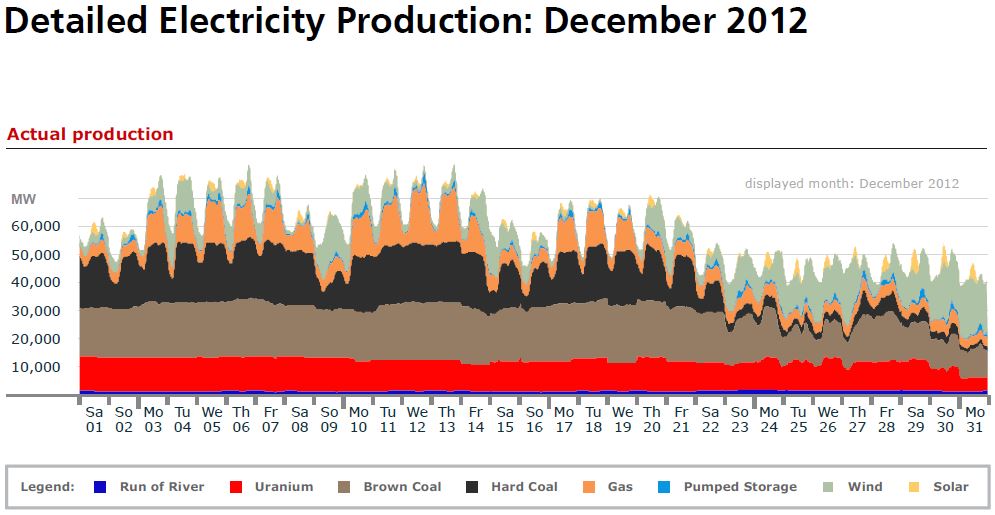
Also from the Fraunhofer report referenced above, the chart below provides details on Germany's electricity production for December, 2012. One can observe in the chart the excessive variability in renewable energy resources, and the compensating for renewable intermittency by ramping both natural gas and hard coal generation resources, while essentially base-loading nuclear and soft coal resources.
It can be observed that natural gas is lower in the merit order loading for economic dispatch relative to coal and nuclear resources, and is called upon extensively to dynamically balance supply and demand.
Showing posts with label wind power. Show all posts
Saturday, March 23, 2013
Saturday, October 11, 2008
The United States: The Saudi Arabia of Wind
Introduction

The United States has the opportunity to meet all of its growing demand for electricity with wind power. Wind is an economic clean energy source with significant scale, as well as being domestically produced. It is an important part of our new energy strategy to strengthen our economy, reduce carbon emissions, and enhance our balance of trade, comprised of four fundamental strategies: (1) Accelerated Renewable Electricity - principally wind as well as biomass and solar; (2) Super Efficient Transportation with plug hyper-hybrids; (3) hyper efficient end-use technologies - focusing on very high efficiency combined heat and power and geothermal heat pumps, along with efficient lighting and appliances; and (4) hyper efficient buildings embracing envelope, controls and systems. This article focuses on wind.
United States - The Saudi Arabia of Wind
The wind resource in the United States is known as the Saudi Arabia of Wind. In 2001, Lester Brown of the World Watch Institute referred to the U. S. wind resource as the Saudi Arabia of wind power, identifying three states that could meet 100% of the U.S. electrical requirements: North Dakota, Kansas and Texas. Lester Brown was writing an article in response to the Bush energy plan of that time, with limited wind. He considered it a plan for the early twentieth century instead of the twenty-first century because of its emphasis on coal, and diminishment of wind as a resource.
More recently, there are two prominent players on the national stage that are referring to the Saudi Arabia of Wind, namely T. Boone Pickens and the former governor of Maine, Angus King. The Pickens Plan is promoting a significant wind development project, amounting to 4 gigawatt wind project, five times larger than any other project. He is developing is project in the Texas Panhandle. Angus King uses the term as well, referring to the Gulf of Maine as the Saudi Arabia of Wind. He is developing a project that is a 5 giga watt project off the coast of Maine.
According to the American Wind Energy Association, the achievable wind resource in the United States is equivalent to twice what we need, with wind able to provide 10.7 trillion kWhs per year, leveraging just the available resources on land. Most of this resource would be realized in just twenty states. Simply put, we have an extraordinary amount of available wind resources to drive our economy forward, creating jobs, clean energy and reducing foreign dependancy for our resources.
Wind Power Economics
Wind is frequently referred to as being competitive with coal power plants. There are many factors which come into play, which determine the resulting economics of wind power installations. These factors include site specific influences, specific wind turbine design and size, as well as state and federal incentives.
Wind Resource - One of the most critical factors impacting the economics of a specific wind development is the location relative to the wind profile. Wind profiles are categorized by the quality of the wind, represented by seven classes that correlate to Wind Power Density (watts/meter squared). It is critical that any wind project seek to maximize the potential energy yield based on the wind profile of each specific location.
When characterizing the wind resource, the amount of energy in the wind increases with the square of its speed, such that average wind speed is not an adequate measure of the energy potential in the wind. Also, the wind speed at which the wind turbine cuts in and cuts out is a critical factor in determining how much of the wind resource is realizable.
Wind Turbine - The choice of wind turbine is important in two principal regards - the size of the turbine and its power curve, i.e., rated output at different wind speeds. In the past ten years, the average size of wind turbines installed in the United States has doubled, from just over 700 kW in 1997 to 1.6 MW in 2006. These larger wind turbines are more efficient per unit of energy generated per dollar invested due to scale economies, more efficient designs, lower cut in speeds, and lower manufacturing costs. In the past two years, however, turbine costs have increased along with increased global demand for wind turbines and increasing commodity materials' costs.
Production Tax Credit - The economics of wind projects are enhanced by the variety of financial incentives provided at state, regional and federal levels. One of the important economic contributors in the United States is the Renewable Electricity Production Tax Credit. The PTC provides tax credits on a per kWh basis for specific renewable electricity sources. The credit for wind is 2 cents per kWh.
Renewable Portfolio Standards - Currently, 24 states and the District of Columbia have instituted renewable portfolio standards that require electricity generators to provide a specific percentage of their energy in the form of renewable energy. These 24 states and the District of Columbia represent approximately 50% of all of the electricity consumed in the United States. RPS requires electricity suppliers to sell an increasing percentage of renewable electricity, which they can satisfy either by producing or purchasing qualifying renewable electricity, purchasing renewable energy credits, or by paying penalties. In Massachusetts, for example, retail electricity suppliers must provide a minimum of 4% of their retail kWh sales from renewable sources in 2009. The required percentage is increasing by 1 percentage point each year without end. RPS standards result in increasing the demand for renewable energy resources, creating a higher market price for wind power.
Renewable Energy Credits, Renewable Energy Certificates, Green Tags and Carbon Offsets - Global warming concerns have resulted in a range of voluntary and compliance initiatives to decarbonize our energy resources and economic activities around the world. For wind power developers, the opportunity exists to monetize the environmental attributes associated with electricity production. These environmental attributes can either be retired or applied to meet social or obligatory environmental objectives. For example, compliance RECs in Connecticut are about $25/MMWh for Tier 1 renewables, and $45/MWh in Massachusetts. Solar RECs in New Jersey are about $265/MWh, while RECs in Texas are selling for about $5.25, with pricing reported for July, 2008 as reported by Evolution Markets. Voluntary REC markets are pricing wind from $3 to $9/MWh in regional and National markets (source: Evolution Markets).
Accelerated Depreciation - Wind projects also qualify for 5 year accelerated depreciation schedules.
Land versus Water - Water based installations are typically more expensive from a capital installation cost perspective than land based installations, yet offer significant counterbalancing financial benefits. The cost of supporting an ocean based turbine can result in an increase of about 35% to the total cost. On the other hand, the wind resource in the ocean is typically greater and more consistent, the projects can be much larger, and can be closer to population centers, reducing transmission losses. For example, the installed cost per kW could be $1,200/kW on land, while costing as much as $1,500/kW in the ocean. The favorable aspects can more than outweigh the disadvantages, especially with recent advances in sea based tower designs.
Summary
The results of these economic drivers is that an unsubsidized wind energy project today can produce electricity for about 4 cents per kWh, as compared to 5 cents per kWh 2000, and 40 cents per kWh in 1979.
Wind power installations in the United States are growing at approximately 35-40% per year, with the current installed based of wind power projects exceeds 20,000 MW, with another 9,000 currently under construction, according to the American Wind Energy Association.

The US Department of Energy, along with AWEA and others now expect that achieving 20% electricity market penetration by 2030 is achievable, representing approximately 300,000 MW of connected load, according to the US DOE and AWEA. Based on recent trends driving wind power costs down, coupled with the identification of large scale locations favorable for development, it is very likely that we will realize an even greater level of wind power in the United States. The effect of achieving this level of wind power development will be significant in terms of job creation, electricity price stabilization, and environmental benefits.
Labels:
clean energy,
Saudi Arabia of Wind,
wind power
Friday, September 12, 2008
T. Boone Pickens, Wind Power and the Pickens Plan
In a strange twist, during a time of the highest oil prices ever recorded, an oil man is placing the biggest bet of his life on wind, water and natural gas. Earlier this year, T. Boone Pickens placed approximately a $1.3 billion order with General Electric for 667 1.5 MW wind turbines, as the first phase of his 4 Giga Watt Pampa Wind Project in the Texas panhandle. The Pampa Wind Project will be complete by 2014 and will be five time larger than the next largest wind project in the United States. The overall project is expected to entail an investment of approximately $8 billion over the next six years in installing the wind farm. But that's not all...
Mr. Pickens is also overlaying additional investments and initiatives to create valuable synergy across his portfolio of investments. His Pickens Plan is publicly encouraging wind development and the conversion of cars to natural gas. In addition, he has acquired water rights in the same area as his wind farm. His Pickens Plan, presented in the public interest, when coupled with his corresponding wind, water and natural gas investments, could be worth billions in coming years. Below, let's review the magic of Pickens' Synergy.
CREZs - One important innovation aiding Mr. Pickens in his plans is the creation by the Texas Legislature of Competitive Renewable Energy Zones (CREZs) as part of Senate Bill 20. These CREZs address the critical challenge of linking wind resources to the electric grid, with the identification of 25 zones where wind power could be profitably developed, and having the state agree to build transmission lines out to those zones. The panhandle is one of those zones, a critical enabling lynchpin in Mr. Pickens' plans.
PTC - Mr. Pickens is also very supportive of another source of value for his project, the Wind Energy Production Tax Credit, which is expiring at the end of this year. The PTC is a tax incentive that was created with the Energy Policy Act of 1992 (EPACT 1992). The PTC provides an income tax credit of 2 cents per kWh for electricity produced over a ten year period by qualified wind energy facilities and other renewable projects placed in service after December 31, 1992, and before January 1, 2009. The amount of the tax credit has been adjusted over the years for inflation, with the original credit set at 1.5 cents in 1992.
Over the years since 1992, the PTC has lapsed three times, each with a significant negative impacts on the level of annual wind plant installations, seen in the chart below from teh American Wind Energy Association (AWEA).
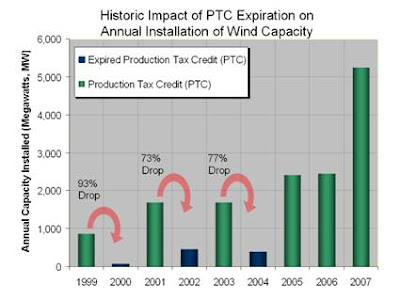
The PTC is currently up for renewal in Congress. The House has consistently passed PTC language in several bill, but unfortunately the Senate has had a difficult time of it, holding eight votes on legislation incorporating the PTC, but approving the extension on only one occasion. Apparently, the reason why the Congress has been having a difficult time passing the legislation is not the fundamentals associated with PTC, but it runs counter to a new policy in Congress that requires every spending proposal or tax cut specifically linked either to a spending reduction or a revenue source. Although this policy was broadly instituted by the Democrats, it is the Republicans that are requiring the identification of a counterbalancing source of revenues for the PTC before providing passage. The Democrats in his case are arguing that the PTC is grandfathered in, thus obviating the need for applying the offsetting revenue source.
Water - Pickens has also been buying up water rights in the same area that he is building his wind project, focused in on Roberts County in the northwest portion of the panhandle. His new company Mesa Water, has purchased the ground water rights of 200,000 acres in Roberts County for $75 million, expecting to make $1 billion over the next 30 years. His plan is to take water from the Ogallala Aquifer and pipe it to one or more major cities in Texas, distributing approximately 200,000 acre feet per year. Water below - wind turbines on top. Interesting source of synergy.
Natural Gas - The Pickens plan also is promoting the move to natural gas based vehicles, to address security and economic issues associated with importing petroleum, and to reduce emissions. One cannot overlook, however, that Mr. Pickens, through his investment vehicle BP Capital Holdings, owns stock in nine companies involved in natural gas exploration and production amounting to a stock value of $838 million. Converting 220 million vehicles to run on natural gas would increase natural gas demand by 80% over current demand in the United States of 21.7 trillion cubic feet per year to 39.0 trillion cubic feet. Even if we converted only 25% of our cars to run on natural gas, this would amount to a 20% increase in demand for a resource that is getting harder to find, and one that is increasingly being sourced globally through importation of liquified natural gas.
Summary - In summary, Mr. Pickens remains a very astute business person, even in his eighth decade. He could make a billion dollars off of his wind investment, a billion dollars off of his water investment, and a billion dollars off of his natural gas investment. Not bad for a reformed oil person who has become a clean energy advocate.
Subscribe to:
Posts (Atom)