Sunday, March 17, 2013

Tectonic Shift in US Transportation Continued in 2012

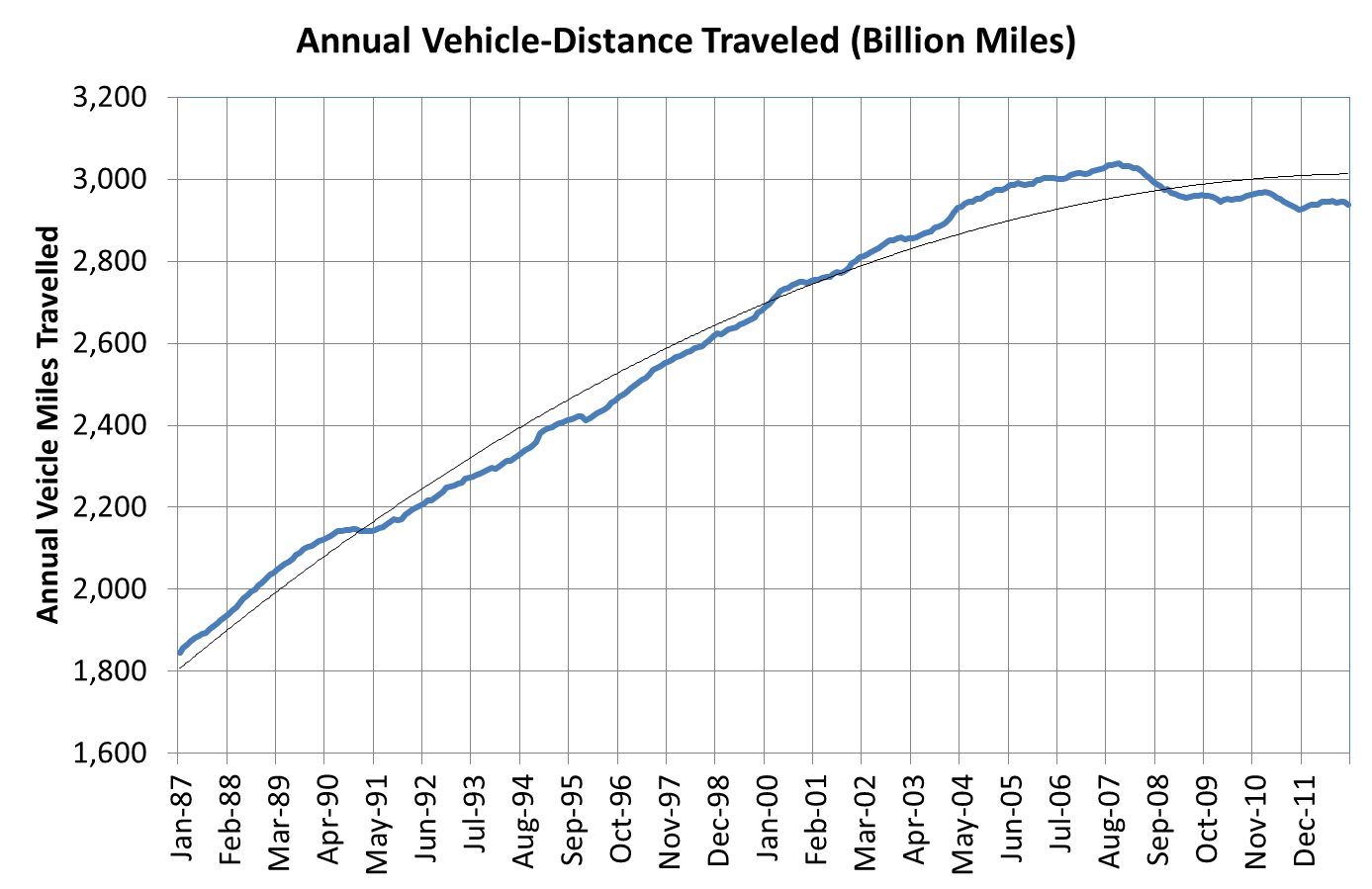
Transportation in the United States continued its tectonic shift in 2012, with gasoline sales and miles driven continuing to decline, and model year fleet efficiency continuing to climb.  Never before, over decades of data, have miles driven not returned to their pre-recession levels by this stage in an economic recovery.  These changes generally bode well for the US economy and households, with benefits including:

  • Reduced oil imports; 
  • Favorable impact on international balance of trade;
  • Reduced pressure on the dollar against foreign currencies; and
  • Favorable impact on household finances, with fewer dollars spent on gasoline.
The contrary position is that these changes are a result of significant economic pain across our economy, due to high and prolonged oil prices, that have caused prolonged economic dislocation, evidenced by continued high unemployment, restrained consumer spending and economic growth below expectations and below average.  These observations are evidenced in the data provided below.

Gasoline sales in 2012, seen in the chart below, are at a level not seen since 1997, and are 8% below the peak set in 2005.   


Vehicle miles driven peaked in the United States in 2007, seen in the chart below, at 3,026 billion miles, and, in 2012, was 2,942 billion miles, 2.8% below the 2007 peak.


Model year vehicle efficiency continues to grow, as seen in the chart below, 2012 average miles per gallon of vehicles sold was 23.9 MPG, which is a 14% increase over the vehicles sold in 2008 of 20.9 mpg.


Sources:

  1. United States Energy Information Agency
  2. United States Department of Transportation
  3. United States Environmental Protection Agency


Saturday, March 16, 2013

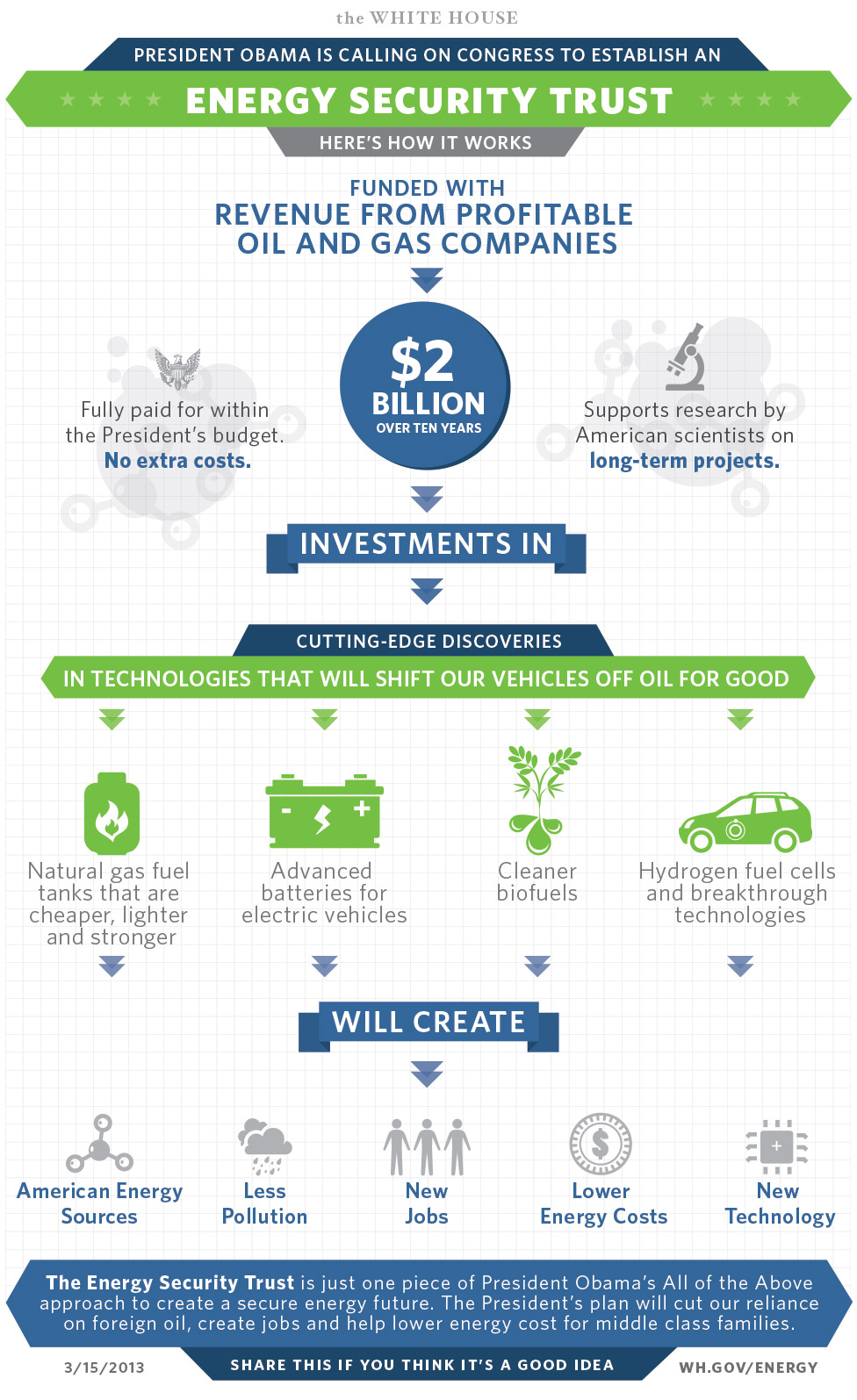
President Obama Proposes $2 billion Energy Security Trust to Fund Alternative Transportation Fuels


President Obama, (See Video Here) while touring the Argonne National Laboratory outside Chicago on Friday, introduced his plan for an Energy Security Trust to accelerate the development of alternative fuels for transportation.  The objective is to reduce the impact on America's families and the economy from high priced and volatile oil.  The plan is designed to be revenue neutral, drawing upon $2 billion of oil and gas offshore gas and oil drilling royalties over ten years, to fund technologies including advanced batteries, biofuels, natural gas fuel tanks, hydrogen fuel cells.

"Over 10 years, the Energy Security Trust will provide $2 billion for critical, cutting-edge research focused on developing cost-effective transportation alternatives.The funding will be provided by revenues from federal oil and gas development, and will not add any additional costs to the federal budget. The investments will support research into a range of technologies – things like advanced vehicles that run on electricity, homegrown biofuels, and domestically produced natural gas. It will also help fund a small number of real-world experiments that try different transportation techniques in cities and towns around the country using advanced vehicles at scale."

Friday, March 15, 2013

Natural Gas Prices Increase 65% in 12 Months

Natural gas prices have been increasing over the past twelve months, rising from a low of below $2 per MMBtu in April, 2012 to over $3.50 per MMBtu this week.

The market is adjusting to key price factors, including:
  1. Continued expansion and increased utilization of natural gas fired power plants creating high demand;
  2. Natural gas fracking requires higher natural gas pricing to support capital investments based on expected returns.  Capital formation for fracking has gone flat due to low natural gas prices;
  3. Plans to export natural gas (LNG) to higher cost European markets creates support for a higher price floor.
For more on the natural gas market, please see the following:


Thursday, March 14, 2013

Smart Grid Company Silver Spring Networks' NASDAQ IPO Raises $81 Million - Shares Surge 29% on First Day of Trading


Smart Grid Company Silver Spring Networks raises $81 million in long awaited IPO, with shares surging 29% on the first day of trading.  This IPO puts the company's valuation at approximately $750 million, and gives the company access to capital markets, an important source of capital to fund the company's operations going forward.  There are a few points to raise regarding this offering:

  1. The company sold 4.75 million shares, up from the 3.75 million shares it had expected to sell as of last week;
  2. None of the existing investors sold their shares in the IPO, preferring to hold onto their investments;
  3. The company has raised approximately $303 million in debt and equity since 2004;
  4. 2012 revenues of $197 million are 17% lower than 2011 revenues of $237;
  5. Silver Spring Networks lost close to $90 million in 2012, a number that has to get smaller very fast, or the company runs the risk of approaching subsequent capital raises just to fund negative margin operations; 
  6. The majority of the company's revenues come from 7 major United States utility customers; and
  7. The boom in smart meter deployments in the United States has subsided.

The basis for the company's valuation and future growth prospects is premised on the following:

  1. Leverage the Installed Base - Silver Spring Networks' deployed smart grid communications networks are platforms for deploying additional products and services up and down the energy value chain, from DSCADA to improve utility grid performance and operation, to leveraging the customer interface for utilities, and into the customer's premise, providing energy management control and data acquisition for customers.  Demand response, for example, represented a very small proportion of hte company's revenues;
  2. Expand Internationally - The opportunity for smart grid deployments and AMI continues to expand internationally, recognizing that Silver Spring Networks already has customer relationships in Australia, Brazil, the UK and Singapore.  International only accounted for an estimated 8% of revenues in 2012. 
  3. Deploy Additional Equipment and Services - Much like Itron, Silver Spring Networks has the opportunity to leverage its stock to acquire additional equipment and software companies to layer additional revenue generating services on top of their smart grid platform.
  4. Expand Into Additional Markets - Silver Spring Networks also has the opportunity to deploy their communications networks and solutions in gas and water industries, as well as selectively targeting other network and industrial businesses that can use their wide area energy management capabilities, perhaps including trains and natural gas pipelines.

At the end of the day, for this IPO to be successful, the Silver Spring Networks has to have a brilliant execution strategy over the next 12 months in order to demonstrate that they can meet the expectations embodied in this first day of trading.  Critical will be (1) turning around the decline in revenues; (2) reducing losses on a quarterly basis to demonstrate being on a pathway to a sustainable cash flow; (3) demonstrating success in expanding into new international markets; and (4) demonstrating their ability to expand products and services to leverage their core network platform.

Wednesday, March 13, 2013

Commercial Fleet Hybrid-Electric Powertrain Company, XL Hybrids, Secures $4 Million In Series B Investment

XL Hybrids, a Fleet Hybrid Conversion company, announced today that they secured $4 million in a Series B investment to fund the growth of their hybrid electric powertrain business. XL Hybrids designed an add-on hybrid-electric solution for commercial fleets to improve their fuel efficiency by 20% or more, without making major modifications to existing OEM vehicles in commercial service. Their add-on solution, seen in the image below, captures and stores energy through regenerative braking.

 
 The XL Hybrids system is designed to work on the most popular Class 1-3 fleet vehicles, including cargo/utility/shuttle vans and pickup trucks. The hybrid drive train is installed either as a retrofit to an existing vehicle, or installed as an upfit onto a new vehicle before delivery. The system is installed through a nationwide network of certified installation partners.

The system consists of a 40 kW Peak Power Permanent Magnet Electric Motor coupled with a 2 kWh Lithium-Ion Battery and Control System, delivering 220 lb-ft of peak torque.

From the company:
PRESS RELEASE

XL Hybrids Secures $4 Million In Series B Investment Financing
Will Support Product Growth Throughout North America
 BOSTON, March 13, 2013 – XL Hybrids, Inc., provider of a low-cost hybrid electric powertrain designed for class 1 to 3 commercial fleet vehicles, today announced that it has raised $4 million in a series B investment round led by private investors, with previous investors also participating in the round. After developing its hybrid powertrain technology and validating it in the field with multiple Fortune 500 companies, XL Hybrids will use this funding to ramp up the delivery of its hybrid electric powertrain to existing and new customers.

Investors in this round include successful entrepreneurs and leading business executives from multiple industries, including automotive, energy, software and finance. While massive government loans and other sources of funding dry up for many cleantech companies, XL Hybrids has proven its ability to deliver fuel savings with a cost-effective technology, sell to large Fortune 500 companies and implement a capital-efficient business model. XL Hybrids’ hybrid electric powertrain reduces fuel consumption by 20 percent and can be installed in both new and existing vehicles. This type of system is ideal for companies operating commercial vans, box-trucks and shuttles in and around major urban markets.

“This round of investment enables us to start scaling our business and expanding our geographic reach. We are working with customers that have large national and international fleets, and we can now help them save fuel and money at a larger scale,” said Tod Hynes, president and founder of XL Hybrids. “With support from our investors, XL Hybrids will continue to expand the availability of our hybrid powertrain and meet the demands of commercial fleets looking for a proven return on investment and reduced emissions.”

This latest investment round brings the total amount of funding for XL Hybrids to approximately $8 million. Earlier this quarter, XL Hybrids expanded its product line to offer hybrid powertrain technology for Ford E-Series vans; the company can now offer a compelling return on investment and significant emissions reductions to more than 75 percent of light duty van fleet buyers. XL Hybrids also signed an installation partnership and distribution agreement with Leggett & Platt Commercial Vehicle Products (CVP), providing its customers with ship-through ordering.

 For more information on XL Hybrids technology and availability, visit www.xlhybrids.comor email info [at] xlhybrids.com.

 About XL Hybrids
 XL Hybrids designs, manufactures and installs hybrid electric powertrains for commercial vans and trucks. The company’s patent-pending hybrid electric powertrain can be installed on existing vehicles or as an upfit on new ones. By storing energy wasted in braking and reapplying it during acceleration, XL Hybrids technology decreases fuel use and carbon dioxide emissions by up to 21.2 percent on urban routes, while operating with the same durability and reliability as traditional vans and trucks. XL Hybrids was founded by MIT alumni and is based in Boston. For more information, visit www.xlhybrids.com.

Tuesday, February 19, 2013

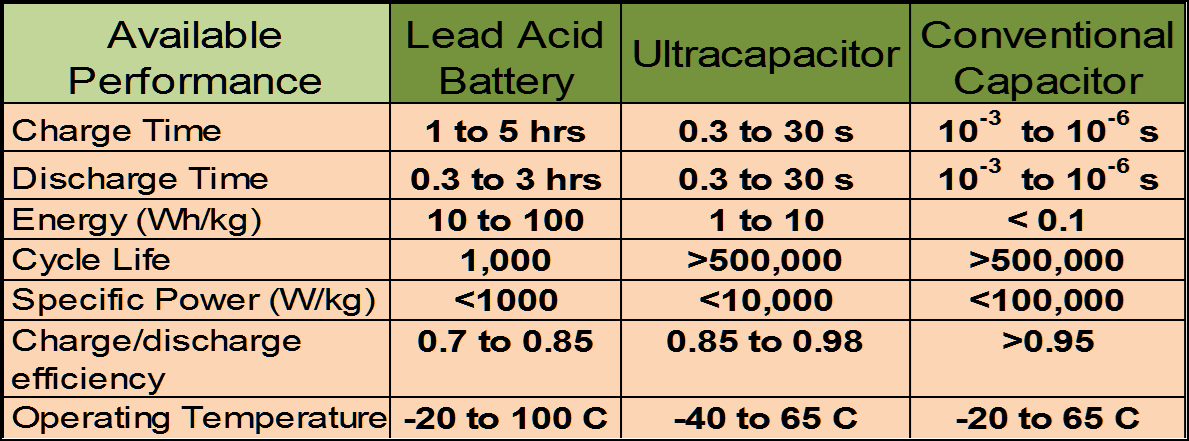
Capacitors versus Batteries

Here is a chart comparing batteries with capacitors: Source: www.tecategroup.com

Monday, February 18, 2013

Alberta's Energy Boom and Revenues Subsiding

Alberta, Canada's primary energy production is heavily weighed towards natural gas, representing approximately 80% of the energy content of oil and natural gas produced. From 2006 to 2010, natural gas production declined 21%, due to North American natural gas price declines due to increased supply in the lower forty-eight with the fracking boom. The graph below is from Alberta's Natural Gas Industry Quarterly Update, Summer 2012: http://www.albertacanada.com/files/albertacanada/NGas_QuarterlyUpdate_Summer2012.pdf It shows the precipitous decline in Alberta's natural gas exports.

Sunday, January 3, 2010

Falling Water Tables Threaten Agricultural Production and Populations Around the World

Falling water tables around the world are threatening agricultural production and the livelihoods and well being of millions of people. Farmers are digging deeper wells, in some cases applying oil drilling techniques to reach water up to 400 meters below the surface. Farmers are also running larger electric water pumps around the clock, creating challenges in the power sector and increasing agricultural costs . In India, for example, power companies spend approximately $9 billion per year subsidizing power for irrigation, twice as much as the country spends on education. Examples include:
  • India - In North Gujaret, the water table is falling by 20 feet per year. In Tamil Nadu, the drying wells have reduced the amount of irrigated farm land by 50 percent in the last ten years.
  • Pakistan - In Rawalpindi and Islamabad, waters tables fell an average between 1 and 2 meters per year between 1982 and 2000. In Baluchistan, water tables are falling approximately 3.5 meters per year.
  • Iran - In the Chenaran Plain, in northeastern Iran, water tables were falling by 2.8 meters per year in the late 1990s.
  • United States - Water from the Ogallala aquifier, which stores water for Nebraska, Oklahoma and Texas, is being withdrawn between 130 and 160 percent above its replacement rate, leading to possibly being depleted within 40 years.
The critical concern over time is the continued overdraft of subsurface and surface water resources at the same time that increasing populations are creating greater demand on agriculatural production. Our global agricultural system is drawing upon water resources at rates that exceed the natural and sustainable replenishment rates. In rural areas of India, farmers are spending successively more resources to acquire water, by drilling deeper wells and running pumps longer. In some cases, towns are abandoning their wells, governments are trucking in water, and people are migrating away from water-poor locations.

More sustainable agricultural practices have to be adopted to reverse the accelerating depletion of available fresh water resources. Similar to the peak oil analysis done by Shell geologist M. King Hubbert in 1956, there is an explicit amount of fresh water resource available at any one time, governed by its natural replenishment rate. Unless we utilize water resources in a manner governed by natural replenishment rates, billions of people are at risk for the two most fundamental requirements for survival: food and water.

Saturday, January 2, 2010

Glacial Melting Threatening Populations Around the Globe

Glaciers around the world are disappearing on an accelerated basis, disrupting water flows upon which humans have depended for thousands of years. These climate driven changes are creating water shortages for entire populations, forcing governments to consider mass migrations in the interest of survival. In most cases, these aggressive reductions in water availability are occurring in places where the resources just do not exist to put adequate alternatives in place in time.

One place where this is occurring is Bolivia, where the existence of 100 million people in the region is threatened with the complete melting of most of the glaciers in the Andes within the next twenty years (according to the World Bank, as reported in the New York Times, December 14, 2009). In 2009, the Chacaltaya glacier, approximately 30 kilometers from La Paz, Bolivia disappeared. Water for La Paz comes from a cluster of nearby glaciers, which have lost 35 percent of their ice mass since 1983. Accordingly, the loss of Chacaltaya is the canary in the coal mine.

The first water migrations have begun, with people moving from Palca, which is in the mountains near La Paz, to El Alto, a fast growing municipality next to La Paz. Farmers and residents of mountainous villages such as Palca, have already begun to see glacial melt drying up in the summers, when water for their farms is crucial for survival. The next phase of water migrations are expected to drive people out of El Alto, where supply will fall below demand in just a few years, due to the combination of decreasing glacial runoff and increasing demand.

This same scenario is impacting peoples' lives in the Himalayas as well, with Himalayan glaciers having lost 21 percent of their glacial mass since 1962. Approximately 2 billion people in India, China and Pakistan depend on Himalayan glacial melt for irrigation and drinking water. With the first Himalayan glaciers expected to disappear by 2035, eventually significantly curtailing agricultural production, the disruption to millions of people's lives will be significant.

These real and current disruptions to people's lives around the globe, tied to massively disruptive climate change, provide a strong argument for significantly increasing the investment in clean energy technologies, and accelerating the deployment of increased efficiency and renewable energy throughout our economies.


Thursday, December 31, 2009

Creating Jobs, Strengthening the Economy and Increasing Energy Independance through a Manhattan Style Energy Efficiency Program

The number of households receiving federal aid for heating their homes increased dramatically in the past three years, increasing 43 percent, from 5.8 million homes in 2007 to 8.3 million homes in 2009. According to the New York Times, it is expected that the number will rise to over 10 million in 2010. This $5 billion federal program, known as LIHEAP (Low Income Heating Energy Assistance Program), pays one-half of each home's heating bills. This is a morally necessary expenditure, designed to ensure that people are able to afford keeping warm and healthy, especially given these economically challenging times.

A corresponding program, the federal Weatherization Assistance Program, was budgeted at $250 million for 2009, representing approximately 100,000 homes weatherized per year. Fortunately, in the 2009 American Recovery and Reinvestment Act, the line item for weatherization is $5 billion over an approximate two year period. This increased funding will result in upwards of 700,000 homes being weatherized per year over the next three years, nearly a seven-fold increase. Although this represents an extraordinary increase over the original 2009 budget, it is still too low. Accelerating investment in our country's energy efficiency represents an investment opportunity that will create a large number of jobs, increase disposable household income, while reducing our country's trade deficit, contributing to lower interest rates.

The United States should have a massive Manhattan style national initiative to significantly increase the investment in upgrading our energy using infrastructure, focusing on increasing the efficiency with which we use energy across all sectors of the economy. For example, approximately 115 million homes in the United States use fossil fuels directly or indirectly for heat, including natural gas, oil, propane and electricity. Currently, little is being done to improve the efficiency of the existing furnaces and heating systems in place. We have the resources and technologies available to significantly increase the penetration of geothermal heating systems, solar thermal heating systems, and combined heat and power systems in the residential sector, with extraordinary benefits to accrue to our economy, yet there appears to be little or no national appetite to pursue these technologies.

For example, if we replaced the natural gas furnaces in the country's existing 56 million homes that use natural gas for heat, using high efficiency combined heat and power systems, we would be able to reduce the country's greenhouse gas emissions by approximately 30 percent, while giving homeowners the ability to produce all of their own electricity as a by-product of heating their homes with a much more efficient CHP furnace. It is perhaps an oversight that our country appears to remain fixated on providing massive economic assistance to companies that are too big to fail, and not directing the investment capital where it will do the most benefit - improving the economic well being of our households and small businesses while creating jobs, increasing our energy independence and creating new exportable clean energy technologies through a massive Manhattan style energy efficiency technology development and investment program.