Showing posts with label United States. Show all posts

Thursday, March 21, 2013

Waxman/Whitehouse Carbon Tax Draft

Bicameral Committee introduced draft legislation for a carbon tax.  Below are links to the four key documents and the text of the summary one pager of the draft legislation.

Representative Henry A. Waxman, Senator Sheldon Whitehouse, Representative Earl Blumenauer, and Senator Brian Schatz released draft carbon-pricing legislation and solicited feedback on it from stakeholders and the public.  The legislation would establish the polluter pays principle for dangerous carbon pollution, requiring large emitters to pay for the pollution they emit.

The “discussion draft” contains a new and straightforward approach to putting a price on carbon pollution.  The nation’s largest polluters would have to pay a fee for each ton of pollution they release.  The legislation assigns responsibility for the assessment and collection of the carbon fees based upon the expertise that has already been developed by EPA and the Treasury Department.  Under the discussion draft, EPA’s database of reported emissions would determine the amount of pollution subject to the fee.  The Treasury Department would be responsible for the collection and handling of the fees.


The legislators are specifically requesting feedback on the following questions:

  1. What is the appropriate price per ton for polluters to pay?  The draft contains alternative prices of $15, $25, and $35 per ton for discussion purposes.
  2. How much should the price per ton increase on an annual basis?  The draft contains a range of increases from 2% to 8% per year for discussion purposes.
  3. What are the best ways to return the revenue to the American people?  The discussion draft proposes putting the revenue toward the following goals, and solicits comments on how to best accomplish each:  (1) mitigating energy costs for consumers, especially low-income consumers; (2) reducing the Federal deficit; (3) protecting jobs of workers at trade-vulnerable, energy intensive industries; (4) reducing the tax liability for individuals and businesses; and (5) investing in other activities to reduce carbon pollution and its effects.
  4. How should the carbon fee program interact with state programs that address carbon pollution?

Comments can be submitted by email to cutcarbon@mail.house.gov, with responses being accepted up to April 12, 2013.


  1. One Pager: "Tackling Climate Change and Raising Revenue for the American People, Carbon Pollution Fee Discussion Draft" (March 12, 2013).
  2. Section-by-Section: "Discussion Draft: Fee for Emissions of Carbon Pollution" (March 12, 2013).
  3. Backgrounder: "Carbon Pollution Fees: A New Workable Approach" (March 12, 2013).
  4. Bill Text: Discussion Draft of Carbon Pollution Fee (March 12, 2013).

Below please find the text of the one-pager summary:


Tackling Climate Change and Raising Revenue for the American People
Carbon Pollution Fee Discussion Draft

Carbon pollution from human activity is driving climate change, which is harming our economy, health, and environment. The United States is the second-largest source of annual carbon pollution and has contributed over one-quarter of the cumulative global carbon pollution from human activity. Scientists warn that we must act now to reduce carbon pollution to avoid potentially catastrophic consequences.
The carbon pollution fee program outlined in this discussion draft released by Congressman Waxman (D-CA), Senator Whitehouse (D-RI), Congressman Blumenauer (D-OR), and Senator Schatz (D-HI) will generate substantial revenue while reducing carbon pollution. The draft abides by the following principles:
          Polluting industries should be responsible for the harm they are causing to the American people.
          All revenue generated by the carbon pollution fee should be returned to the American people.
          Trade-vulnerable, energy-intensive industries should be protected.
Specifically, the discussion draft outlines a legislative framework that would:
          Establish a carbon pollution fee that applies to all six categories of greenhouse gases.
          Require large carbon pollution sources to pay the fee for carbon pollution permits based on the quantities of carbon pollution reported by the sources under the EPA’s Greenhouse Gas Reporting Rule.
          Create a program to be jointly administered by the Department of the Treasury and EPA. EPA would implement and enforce emissions reporting under EPA’s Greenhouse Gas Reporting Rule, and Treasury would assess, collect, and enforce the fee requirements at the point where carbon pollution is emitted or passed on to consumers, depending on the type of source.
This approach would:
          Drive significant carbon pollution reductions.
          Generate substantial revenue to be returned to the American people.
          Provide broad coverage of greenhouse gas emissions, while minimizing compliance and administrative burdens and utilizing each agency’s area of expertise.
Comments on any aspect of the discussion draft are welcome, and the lawmakers have identified the following key questions for feedback:
1.      What is the appropriate price per ton for polluters to pay? The draft contains alternative prices of $15, $25, and $35 per ton for discussion purposes.
2.      How much should the price per ton increase on an annual basis? The draft contains a range of increases from 2% to 8% per year for discussion purposes.
3.      What are the best ways to return the revenue to the American people? The discussion draft proposes putting the revenue toward the following goals, and solicits comments on how to best accomplish each: (1) mitigating energy costs for consumers, especially low-income consumers; (2) reduce the federal deficit; (3) protect the jobs of workers at trade-vulnerable, energy intensive industries; (4) reduce the tax liability for individuals and businesses; and (5) invest in other activities to reduce carbon pollution and its impacts.
4.      How should the carbon fee program interact with state programs that address carbon pollution?
Tuesday, March 19, 2013

United States Housing Starts Near Five Year High

United States single family housing starts roared ahead in February to four and one-half year high.  All indications are favorable for a solid recovery in the housing sector, including upward pressures on construction employment and sales of building materials.  In summary:
  1. February single family housing starts, at 618,000 units on an annualized basis, are at a 4 1/2 year high;
  2. Building permits in February increased 4.6% to 946,000, which is the most since June, 2008, and bodes well for future higher levels of construction activity;
  3. February 2013 housing starts represented a 31% growth over February 2012 housing starts;  
  4. Existing home prices in January, 2013, were 10% higher than January 2012, due to a strengthening economy;
  5.  There is a 13 year low in houses on the market for sale, further putting upward pressure on housing prices; and
  6. The outlook for sales over the next six months rose to its highest level in in more than six months.
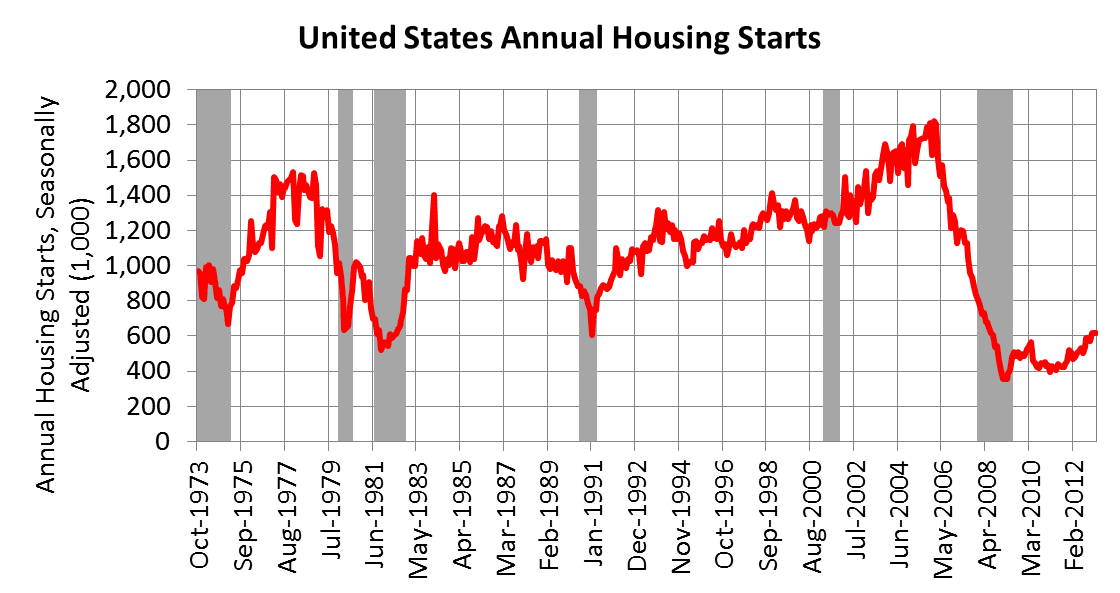
In the chart below, showing housing starts and recessions.  There are a few additional points that can be made.  Note in the chart below that housing starts dropped during the recession to their lowest level in decades.  The recent recovery in housing starts is fantastic from an economic perspective, but the starting point is so depressed, but housing starts have to grow by another 60% before reaching the long term average of close to 1,000 housing starts per year.  

It is also instructive to observe that precipitous falls in housing starts preceded four of the last five recessions.  We can also observe fairly steep housing start run-ups, representing overbuilding that gets out ahead of sustainable market levels.

Finally, one of the concerns noted by home builders, relative to their ability to meet increased demand, is their concern over having access to sufficient labor, land and materials.  Accordingly, it is likely we will see continued increases in construction employment over the next few years, which will be an important contribution to reducing unemployment.

Sources:

  1. United States Census Bureau, U.S. Department of Commerce
  2. Associated Press

Monday, March 18, 2013

United States Solar Market Grows by Leaps and Bounds

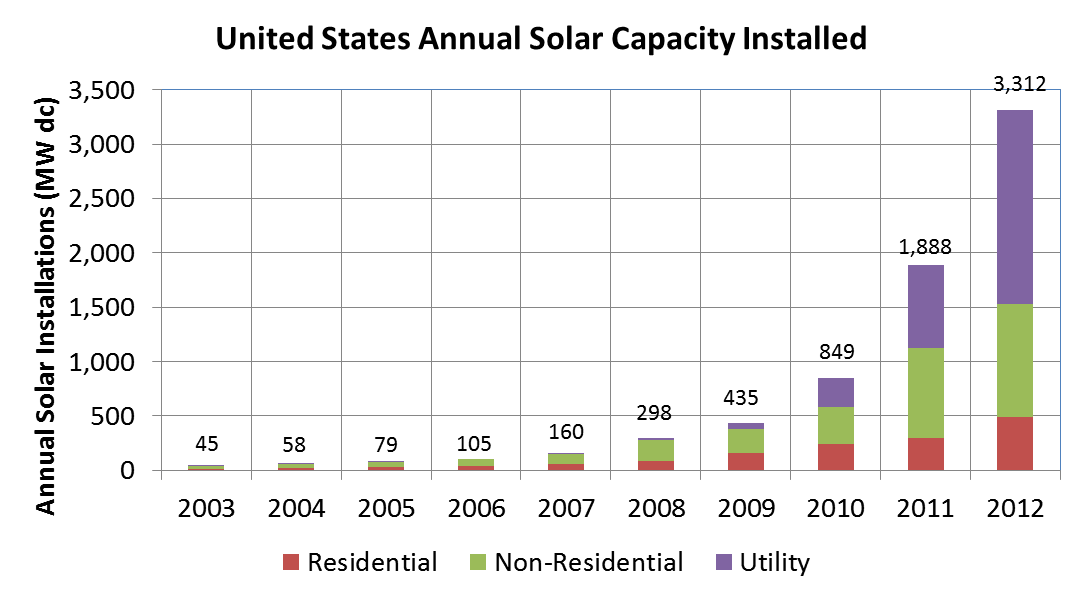
The United States solar market galloped ahead in 2012, growing 75% year-over-year, increasing by 1,424 MW over 2011.  The greatest growth occurred in utility scale projects, increasing by 1,021 GW, representing a 124% annual growth.


The cost of designing, procuring and installing solar PV systems continues its steep decline, with the blended average system price dropping a phenomenal 52% in the past three years.  These continued precipitous drop in solar costs is a boon to the medium to long term economic viability of solar.  In certain markets and applications around the world, solar PV is becoming competitive with grid power.  The most competitive applications are grid scale PV installations where installation costs are approaching $2 per watt all in.  Certain markets around the world also represent attractive markets due to high extant electricity costs from the grid coupled with high solar insolation.

There is some talk in the industry that solar panels in China are heading to 45 cents per watt.  It is also understood that there may be some panel price firming taking place in India, and, at current panel prices, certain solar companies around the world, especially in China where there is a significant over-build in manufacturing capacity, some companies may fail or take on local subsidies to survive.

Deutsche Bank recently released an analysis of global PV markets from the perspective of locations where grid parity will be reached within the next few years.  Grid parity may alread have been reached in India, Southern Italy and Spain, where solar developers are proposing projects without requiring subsidies.

When solar crosses the grid parity threshold, solar becomes ever more competitive with existing sources of power generation.  One of the surprising market dynamics that is being seen in Germany and Texas, is the basis for economic dispatch of power plants being determined by marginal cost to produce the next electron.   Because solar and wind have no fuel costs, this means that are beginning to crowd out fuel-based generating supply.

Once the grid parity threshold is crossed, the adoption of renewables will accelerate, constrained only by capital formation and grid interconnections.

There is another dynamic associated with the economics of wide spread adoptions of solar PV on the grid - long term economics.  Germany has made significant use of feed in tariffs to financially support PV systems.  In the short term, these feed in tariffs exert a large financial  burden on the electric utility companies and their ratepayers.  Once, however, the FIT payment schedules reach the end of their payment schedule, the utiltiies will no longer have to subsidize the solar systems, with the result being free power.  At that point, depending on the ultimate penetration of zero fuel renewable resources, primarily wind and solar, the utilities will have a cost structure focused on grid capitalization and management, and managing generation and storage resources focused on maintaining grid stability and safe reliable power distribution.


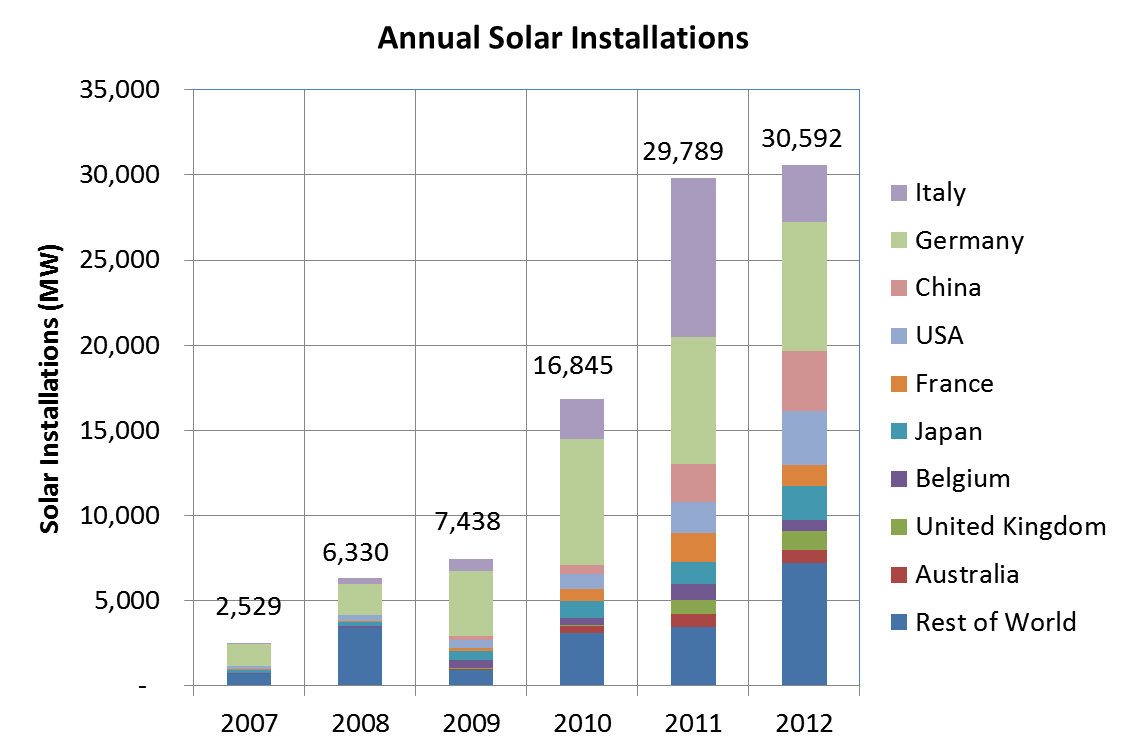
The global market for solar PV has quadrupled in the past three years, increasing from 7,438 MW of installed capacity in 2009, to over 30,000 MW of an estimated installed capacity in 2012, 400% growth.  The annual growth of the global PV market appears to have leveled off between 2011 and 2012.

What is also apparent in the global data is the unevenness of year to year deployment in certain countries.  The pace of deployment in Germany, for example has leveled off over the past three years.  Italy experienced considerable growth in 2011, and has suffered a significant pull back in deployments in 2012, along with France and Spain.

Other countries, such as the United States, China and Japan, are currently seeing significant growth in their solar PV markets.


Sources:

  1. Solar Energy Industry Association
  2. European Photovoltaic Industry Association
  3. Deutsche Bank