Showing posts with label balance of trade. Show all posts

Tuesday, April 9, 2013

Trade Deficit Narrows while Labor Force Participation Drops To Levels Not Seen Since 1979!

Two pieces of economic data stood out this week.  On a favorable note, the United States trade deficit narrowed by 3.4% from January, to $43 billion, with exports climbing to near record levels.  Exports rose to  $186 billion, with strong exports of energy products and automobiles.  Imports were little changed, with crude oil imports at their lowest levels since March, 1996.

Energy plays a central role contributing to the reduction in the deficit, with energy exports increasing on one hand, and energy imports at their lowest level in 17 years.  The reduction in crude oil imports is occurring for several reasons.  As referenced in an earlier blog on transportation, the number of vehicle miles driven has been reducing for several years, at the same time that vehicle efficiency has been going up.  In addition to reduced oil consumption for transportation, the United States has been incrementally increasing our own production of oil domestically.  These two factors have contributed to dampen and reduce the need and demand for crude oil imports.  


Another piece of economic news which stood out this week is the continued reduction in the overall labor force participation rate, explaining for the corresponding reduction in the nation's unemployment rate.  The labor force participation hit 63.3% in March this year, a level not seen since 1979.  Labor force participation peaked in 2000 at 67.3%, and has been declining ever since.

There is some uncertainty as to the cause of the reduction, with some referring to baby boomers leaving the work force, while others are giving up on being active in the job market, choosing to return to school, or stay on the labor force sidelines.  A structural shift appears to be taking place in the economy relative to the labor force.  The types of jobs being offered have transitioned to lower wage jobs and part time jobs.  Many who are unemployed are dragging their feet in taking  less attractive or part time positions.  We have seen higher wage manufacturing jobs being replaced with lower wage service sector jobs.  In addition, we have been seeing governments at the national, state and local levels reducing their employment levels.

There is another factor impacting the labor force.  Corporations, in order to maintain or improve profits with increased costs for energy, are turning to counterbalancing labor force reductions, substituting capital investment in improved productivity while simultaneously outsourcing lower margin activities.  These moves have allowed corporations to maintain or improve earning under scenarios with increased energy costs, leaving the labor force behind.    


Sunday, March 17, 2013

Tectonic Shift in US Transportation Continued in 2012

Transportation in the United States continued its tectonic shift in 2012, with gasoline sales and miles driven continuing to decline, and model year fleet efficiency continuing to climb.  Never before, over decades of data, have miles driven not returned to their pre-recession levels by this stage in an economic recovery.  These changes generally bode well for the US economy and households, with benefits including:

  • Reduced oil imports; 
  • Favorable impact on international balance of trade;
  • Reduced pressure on the dollar against foreign currencies; and
  • Favorable impact on household finances, with fewer dollars spent on gasoline.
The contrary position is that these changes are a result of significant economic pain across our economy, due to high and prolonged oil prices, that have caused prolonged economic dislocation, evidenced by continued high unemployment, restrained consumer spending and economic growth below expectations and below average.  These observations are evidenced in the data provided below.

Gasoline sales in 2012, seen in the chart below, are at a level not seen since 1997, and are 8% below the peak set in 2005.   


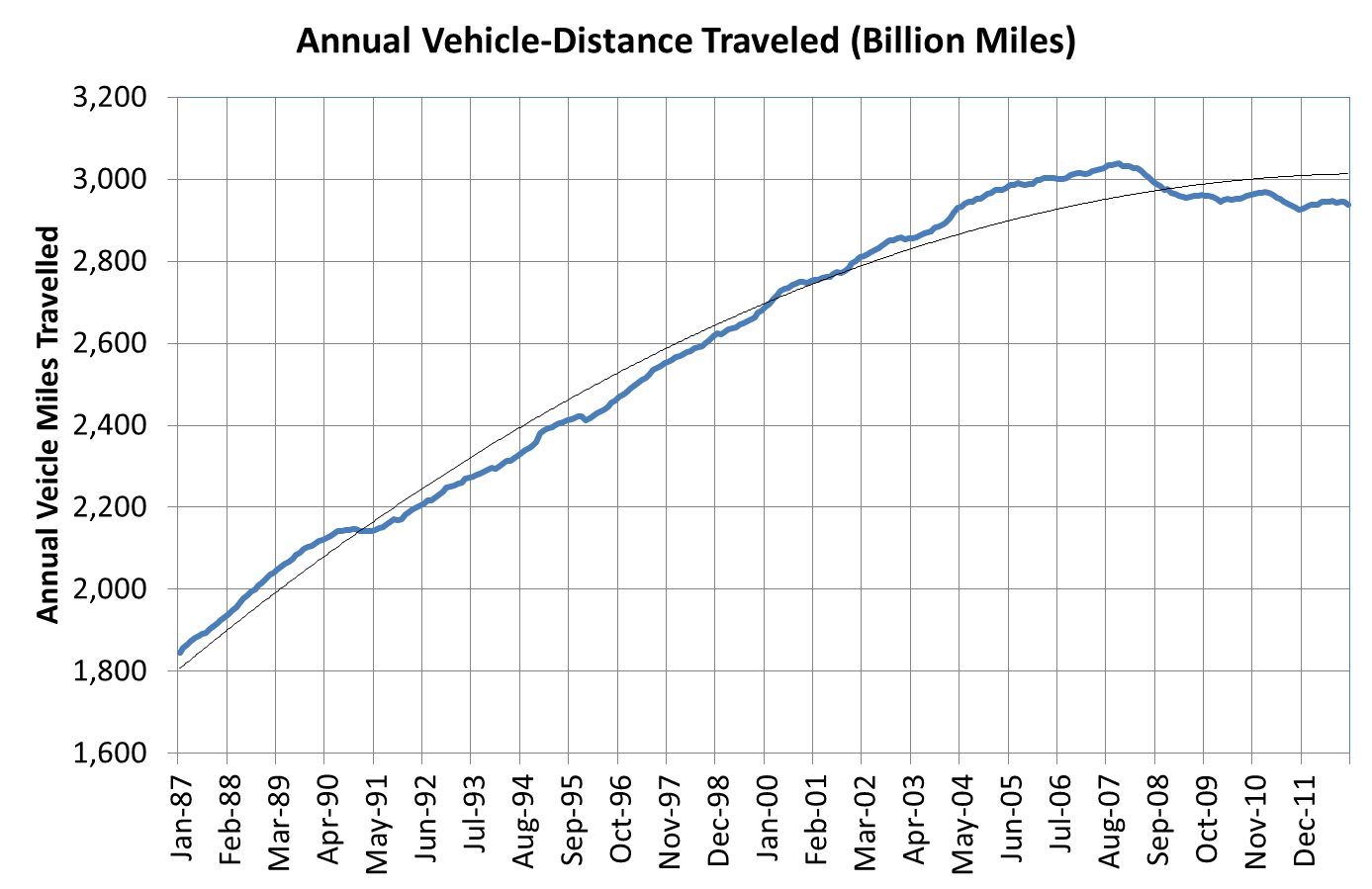
Vehicle miles driven peaked in the United States in 2007, seen in the chart below, at 3,026 billion miles, and, in 2012, was 2,942 billion miles, 2.8% below the 2007 peak.


Model year vehicle efficiency continues to grow, as seen in the chart below, 2012 average miles per gallon of vehicles sold was 23.9 MPG, which is a 14% increase over the vehicles sold in 2008 of 20.9 mpg.


Sources:

  1. United States Energy Information Agency
  2. United States Department of Transportation
  3. United States Environmental Protection Agency