Showing posts with label efficiency. Show all posts

Sunday, March 17, 2013

Tectonic Shift in US Transportation Continued in 2012

Transportation in the United States continued its tectonic shift in 2012, with gasoline sales and miles driven continuing to decline, and model year fleet efficiency continuing to climb.  Never before, over decades of data, have miles driven not returned to their pre-recession levels by this stage in an economic recovery.  These changes generally bode well for the US economy and households, with benefits including:

  • Reduced oil imports; 
  • Favorable impact on international balance of trade;
  • Reduced pressure on the dollar against foreign currencies; and
  • Favorable impact on household finances, with fewer dollars spent on gasoline.
The contrary position is that these changes are a result of significant economic pain across our economy, due to high and prolonged oil prices, that have caused prolonged economic dislocation, evidenced by continued high unemployment, restrained consumer spending and economic growth below expectations and below average.  These observations are evidenced in the data provided below.

Gasoline sales in 2012, seen in the chart below, are at a level not seen since 1997, and are 8% below the peak set in 2005.   


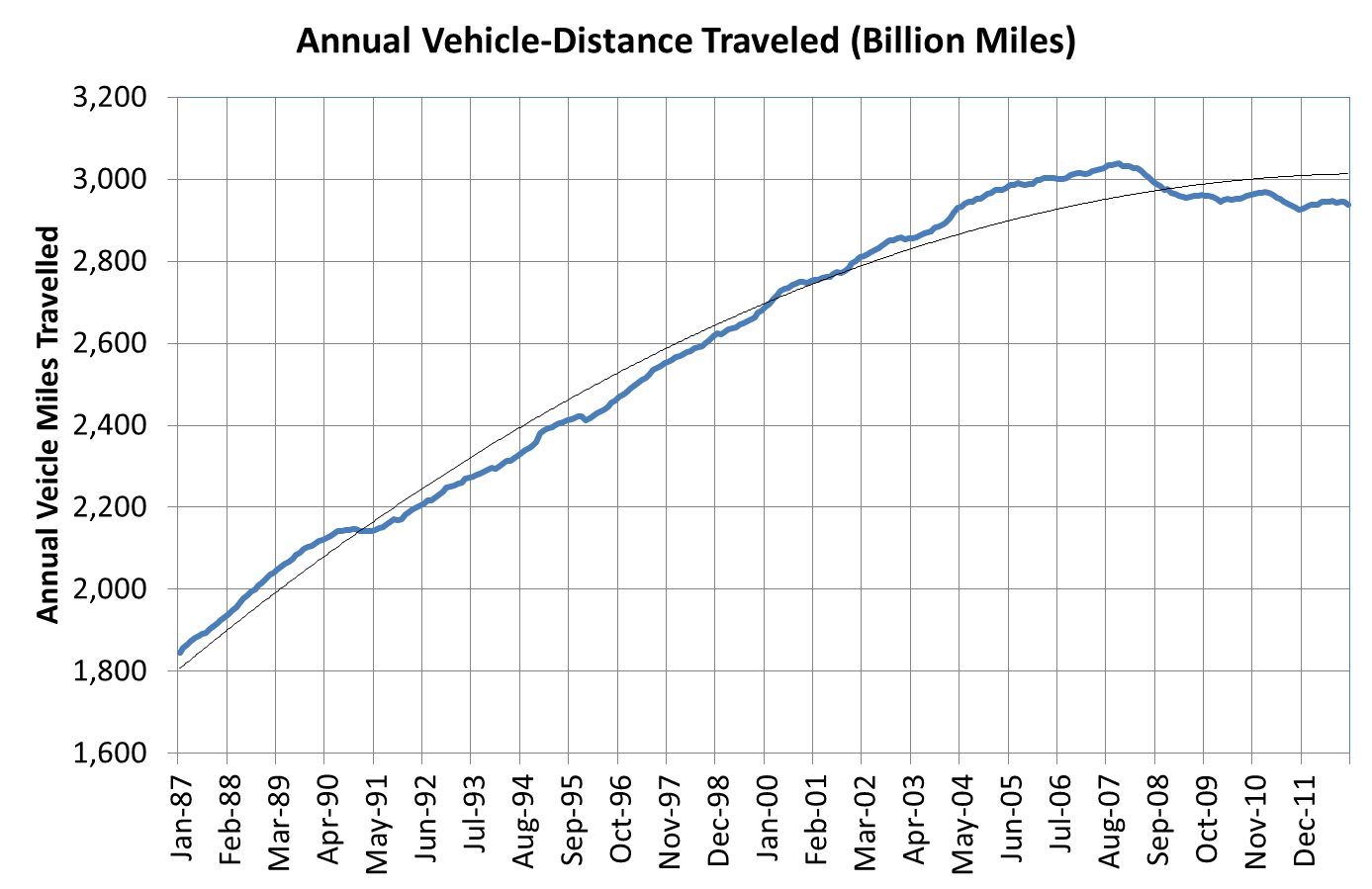
Vehicle miles driven peaked in the United States in 2007, seen in the chart below, at 3,026 billion miles, and, in 2012, was 2,942 billion miles, 2.8% below the 2007 peak.


Model year vehicle efficiency continues to grow, as seen in the chart below, 2012 average miles per gallon of vehicles sold was 23.9 MPG, which is a 14% increase over the vehicles sold in 2008 of 20.9 mpg.


Sources:

  1. United States Energy Information Agency
  2. United States Department of Transportation
  3. United States Environmental Protection Agency


Saturday, January 2, 2010

Glacial Melting Threatening Populations Around the Globe

Glaciers around the world are disappearing on an accelerated basis, disrupting water flows upon which humans have depended for thousands of years. These climate driven changes are creating water shortages for entire populations, forcing governments to consider mass migrations in the interest of survival. In most cases, these aggressive reductions in water availability are occurring in places where the resources just do not exist to put adequate alternatives in place in time.

One place where this is occurring is Bolivia, where the existence of 100 million people in the region is threatened with the complete melting of most of the glaciers in the Andes within the next twenty years (according to the World Bank, as reported in the New York Times, December 14, 2009). In 2009, the Chacaltaya glacier, approximately 30 kilometers from La Paz, Bolivia disappeared. Water for La Paz comes from a cluster of nearby glaciers, which have lost 35 percent of their ice mass since 1983. Accordingly, the loss of Chacaltaya is the canary in the coal mine.

The first water migrations have begun, with people moving from Palca, which is in the mountains near La Paz, to El Alto, a fast growing municipality next to La Paz. Farmers and residents of mountainous villages such as Palca, have already begun to see glacial melt drying up in the summers, when water for their farms is crucial for survival. The next phase of water migrations are expected to drive people out of El Alto, where supply will fall below demand in just a few years, due to the combination of decreasing glacial runoff and increasing demand.

This same scenario is impacting peoples' lives in the Himalayas as well, with Himalayan glaciers having lost 21 percent of their glacial mass since 1962. Approximately 2 billion people in India, China and Pakistan depend on Himalayan glacial melt for irrigation and drinking water. With the first Himalayan glaciers expected to disappear by 2035, eventually significantly curtailing agricultural production, the disruption to millions of people's lives will be significant.

These real and current disruptions to people's lives around the globe, tied to massively disruptive climate change, provide a strong argument for significantly increasing the investment in clean energy technologies, and accelerating the deployment of increased efficiency and renewable energy throughout our economies.


Thursday, December 31, 2009

Creating Jobs, Strengthening the Economy and Increasing Energy Independance through a Manhattan Style Energy Efficiency Program

The number of households receiving federal aid for heating their homes increased dramatically in the past three years, increasing 43 percent, from 5.8 million homes in 2007 to 8.3 million homes in 2009. According to the New York Times, it is expected that the number will rise to over 10 million in 2010. This $5 billion federal program, known as LIHEAP (Low Income Heating Energy Assistance Program), pays one-half of each home's heating bills. This is a morally necessary expenditure, designed to ensure that people are able to afford keeping warm and healthy, especially given these economically challenging times.

A corresponding program, the federal Weatherization Assistance Program, was budgeted at $250 million for 2009, representing approximately 100,000 homes weatherized per year. Fortunately, in the 2009 American Recovery and Reinvestment Act, the line item for weatherization is $5 billion over an approximate two year period. This increased funding will result in upwards of 700,000 homes being weatherized per year over the next three years, nearly a seven-fold increase. Although this represents an extraordinary increase over the original 2009 budget, it is still too low. Accelerating investment in our country's energy efficiency represents an investment opportunity that will create a large number of jobs, increase disposable household income, while reducing our country's trade deficit, contributing to lower interest rates.

The United States should have a massive Manhattan style national initiative to significantly increase the investment in upgrading our energy using infrastructure, focusing on increasing the efficiency with which we use energy across all sectors of the economy. For example, approximately 115 million homes in the United States use fossil fuels directly or indirectly for heat, including natural gas, oil, propane and electricity. Currently, little is being done to improve the efficiency of the existing furnaces and heating systems in place. We have the resources and technologies available to significantly increase the penetration of geothermal heating systems, solar thermal heating systems, and combined heat and power systems in the residential sector, with extraordinary benefits to accrue to our economy, yet there appears to be little or no national appetite to pursue these technologies.

For example, if we replaced the natural gas furnaces in the country's existing 56 million homes that use natural gas for heat, using high efficiency combined heat and power systems, we would be able to reduce the country's greenhouse gas emissions by approximately 30 percent, while giving homeowners the ability to produce all of their own electricity as a by-product of heating their homes with a much more efficient CHP furnace. It is perhaps an oversight that our country appears to remain fixated on providing massive economic assistance to companies that are too big to fail, and not directing the investment capital where it will do the most benefit - improving the economic well being of our households and small businesses while creating jobs, increasing our energy independence and creating new exportable clean energy technologies through a massive Manhattan style energy efficiency technology development and investment program.

Tuesday, October 28, 2008

The Economic Wisdom of Clean Energy

Clean energy offers the best chance we have in this country to take back our future, to create jobs, improve our economy, while enhancing our national security and permanently improving our environment.  The role of government is primarily to secure the national defense, to uniquely act in the collective national interest.  Similarly, the federal government plays a role in numerous other situations where the individual rights need to be protected, or standards of well being need to be upheld, such as economic well being or health.  In times of collective economic woe, the government has a responsibility to do what it can to protect the national well being.  This is one of those times and clean energy is the best vehicles to sustain and enhance our collective well being.

Each dollar invested in clean energy creates jobs, stabilizes and reduces our energy costs, increases productivity, reduces our foreign dependance on energy, creates exportable products and services, enhances our balance of trade, and significantly improves our environment.  The key differentiation with clean energy investments is the significant economic leverage achieved compared to any other investment, known in economic circles as velocity.  In aggregate, any dollar invested by the government usually has one dollar less of velocity as compared to a similar investment by the private sector.  Government begins in a disadvantaged position, caused by the tax effect on money.  Any investment on the part of government, therefore, must really bring unique advantage and not be duplicated in the private sector.  Clean energy fits that paradigm.

This country's clean energy strategy will focus on solutions that are economic, have a large impact, create jobs, increase productivity, improve our balance of trade, and enhance our environment.  The core elements of the three step clean energy strategy include:
  1. Electricity - Accelerate proportion of economic renewable electricity, with a principal focus on enabling wind power.
  2. Transportation - Accelerate the domestic development of very high mileage plug-in hybrids. 
  3. Buildings - Accelerate the adoption of high efficiency end-use central systems, appliances and end-uses, including combined heat and power systems and geothermal heat pumps. 
The first role of government is to reduce the barriers to adoption, by eliminating regulation which discourages or hampers the development of these clean energy sources.  The second role of government is to encourage regulation that enables the development, deployment and adoption of these resources.  This would include tax breaks for developing and deploying these sources of energy.  The third step for government would be to provide financial incentives that directly reduce initial costs, such as tax incentives, rebates and grants.  It is important that the government share of these expenditures be kept low, so as to ensure only the most economic projects are built and that private capital is put to work, leveraging fundamentally scarce public resources.