Wednesday, March 20, 2013

United States Housing Market Turns the Corner - Is Poised for Significant Growth in 2013

All factors point to a very robust 2013 for the United States housing industry:

  1. As observed in the chart below, January housing for sale listings are 47% below their recent peak in July, 2010, and are at their lowest level since 1999;
  2. Job growth has averaged 205,000 over the past four months, adding 820,000 jobs to the economy, which underpins the housing market;
  3. Home construction has been extremely low for the past four years, limiting the available stock and supply of housing units;
  4. House values and the stock market have rebounded, essentially erasing household debts acquired during the recession; and
  5. Share of household income being used to pay off debt is at 10,6%, which is the lowest proportion of income in the past 29 years.
The coincidence of these factors bodes extremely well for growth in the housing industry.  One estimate expects new housing units to increase 40.8% from 2012 to 2013, increasing from 781,000 units to 1,100,000 units.  House prices have experienced their biggest year-over-year jump since May, 2006, according to the CoreLogic home price index, which increased 8.3 percent comparing December 2012 to December 2011.  The housing industry has turned the corner, and is expected to contribute 0.7% to the growth in the economy this year.


Sources:

  1. USA Today
  2. National Association of Realtors


Tuesday, March 19, 2013

United States Housing Starts Near Five Year High

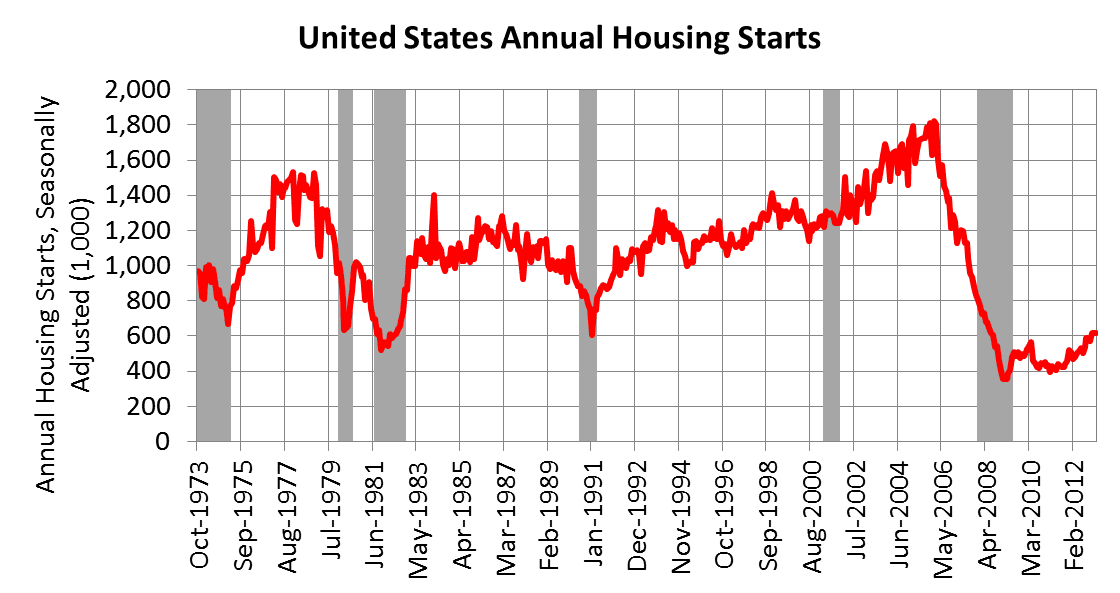
United States single family housing starts roared ahead in February to four and one-half year high.  All indications are favorable for a solid recovery in the housing sector, including upward pressures on construction employment and sales of building materials.  In summary:
  1. February single family housing starts, at 618,000 units on an annualized basis, are at a 4 1/2 year high;
  2. Building permits in February increased 4.6% to 946,000, which is the most since June, 2008, and bodes well for future higher levels of construction activity;
  3. February 2013 housing starts represented a 31% growth over February 2012 housing starts;  
  4. Existing home prices in January, 2013, were 10% higher than January 2012, due to a strengthening economy;
  5.  There is a 13 year low in houses on the market for sale, further putting upward pressure on housing prices; and
  6. The outlook for sales over the next six months rose to its highest level in in more than six months.
In the chart below, showing housing starts and recessions.  There are a few additional points that can be made.  Note in the chart below that housing starts dropped during the recession to their lowest level in decades.  The recent recovery in housing starts is fantastic from an economic perspective, but the starting point is so depressed, but housing starts have to grow by another 60% before reaching the long term average of close to 1,000 housing starts per year.  

It is also instructive to observe that precipitous falls in housing starts preceded four of the last five recessions.  We can also observe fairly steep housing start run-ups, representing overbuilding that gets out ahead of sustainable market levels.

Finally, one of the concerns noted by home builders, relative to their ability to meet increased demand, is their concern over having access to sufficient labor, land and materials.  Accordingly, it is likely we will see continued increases in construction employment over the next few years, which will be an important contribution to reducing unemployment.

Sources:

  1. United States Census Bureau, U.S. Department of Commerce
  2. Associated Press

Monday, March 18, 2013

United States Solar Market Grows by Leaps and Bounds

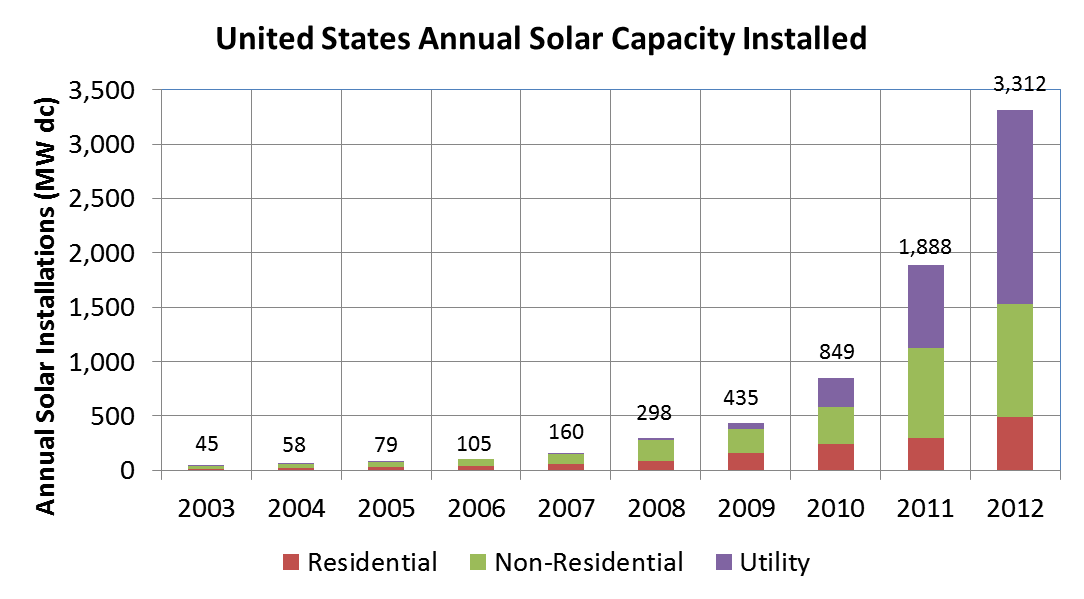
The United States solar market galloped ahead in 2012, growing 75% year-over-year, increasing by 1,424 MW over 2011.  The greatest growth occurred in utility scale projects, increasing by 1,021 GW, representing a 124% annual growth.


The cost of designing, procuring and installing solar PV systems continues its steep decline, with the blended average system price dropping a phenomenal 52% in the past three years.  These continued precipitous drop in solar costs is a boon to the medium to long term economic viability of solar.  In certain markets and applications around the world, solar PV is becoming competitive with grid power.  The most competitive applications are grid scale PV installations where installation costs are approaching $2 per watt all in.  Certain markets around the world also represent attractive markets due to high extant electricity costs from the grid coupled with high solar insolation.

There is some talk in the industry that solar panels in China are heading to 45 cents per watt.  It is also understood that there may be some panel price firming taking place in India, and, at current panel prices, certain solar companies around the world, especially in China where there is a significant over-build in manufacturing capacity, some companies may fail or take on local subsidies to survive.

Deutsche Bank recently released an analysis of global PV markets from the perspective of locations where grid parity will be reached within the next few years.  Grid parity may alread have been reached in India, Southern Italy and Spain, where solar developers are proposing projects without requiring subsidies.

When solar crosses the grid parity threshold, solar becomes ever more competitive with existing sources of power generation.  One of the surprising market dynamics that is being seen in Germany and Texas, is the basis for economic dispatch of power plants being determined by marginal cost to produce the next electron.   Because solar and wind have no fuel costs, this means that are beginning to crowd out fuel-based generating supply.

Once the grid parity threshold is crossed, the adoption of renewables will accelerate, constrained only by capital formation and grid interconnections.

There is another dynamic associated with the economics of wide spread adoptions of solar PV on the grid - long term economics.  Germany has made significant use of feed in tariffs to financially support PV systems.  In the short term, these feed in tariffs exert a large financial  burden on the electric utility companies and their ratepayers.  Once, however, the FIT payment schedules reach the end of their payment schedule, the utiltiies will no longer have to subsidize the solar systems, with the result being free power.  At that point, depending on the ultimate penetration of zero fuel renewable resources, primarily wind and solar, the utilities will have a cost structure focused on grid capitalization and management, and managing generation and storage resources focused on maintaining grid stability and safe reliable power distribution.


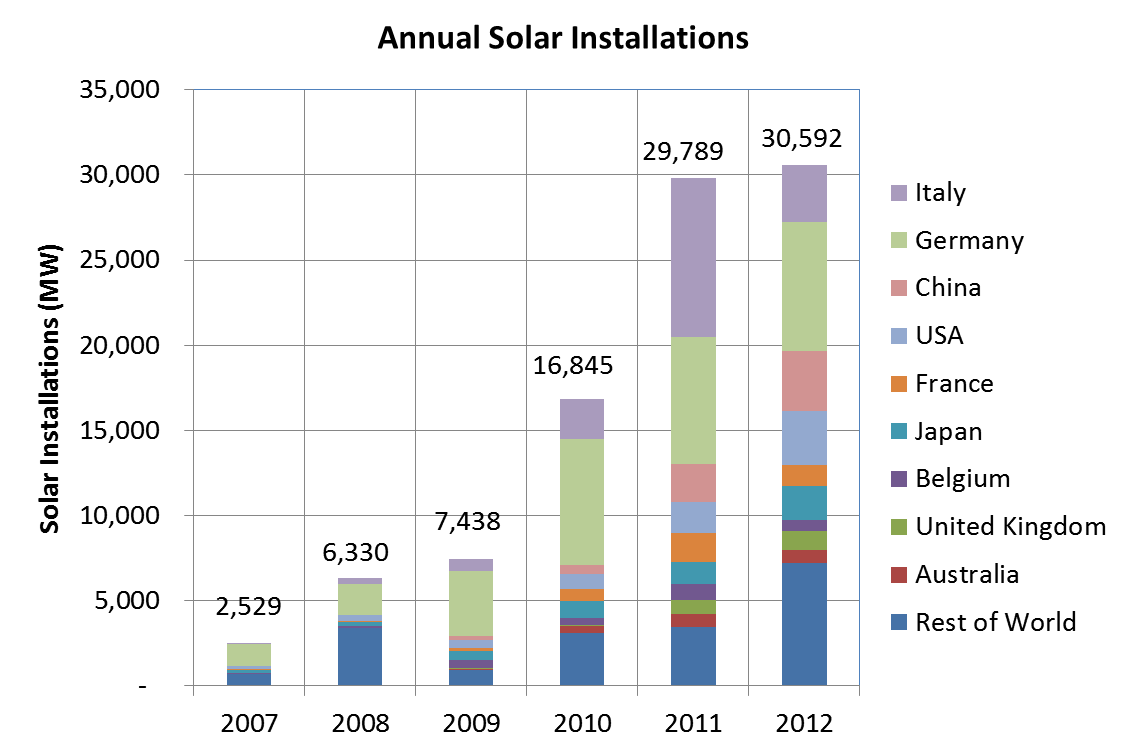
The global market for solar PV has quadrupled in the past three years, increasing from 7,438 MW of installed capacity in 2009, to over 30,000 MW of an estimated installed capacity in 2012, 400% growth.  The annual growth of the global PV market appears to have leveled off between 2011 and 2012.

What is also apparent in the global data is the unevenness of year to year deployment in certain countries.  The pace of deployment in Germany, for example has leveled off over the past three years.  Italy experienced considerable growth in 2011, and has suffered a significant pull back in deployments in 2012, along with France and Spain.

Other countries, such as the United States, China and Japan, are currently seeing significant growth in their solar PV markets.


Sources:

  1. Solar Energy Industry Association
  2. European Photovoltaic Industry Association
  3. Deutsche Bank


Sunday, March 17, 2013

Tectonic Shift in US Transportation Continued in 2012

Transportation in the United States continued its tectonic shift in 2012, with gasoline sales and miles driven continuing to decline, and model year fleet efficiency continuing to climb.  Never before, over decades of data, have miles driven not returned to their pre-recession levels by this stage in an economic recovery.  These changes generally bode well for the US economy and households, with benefits including:

  • Reduced oil imports; 
  • Favorable impact on international balance of trade;
  • Reduced pressure on the dollar against foreign currencies; and
  • Favorable impact on household finances, with fewer dollars spent on gasoline.
The contrary position is that these changes are a result of significant economic pain across our economy, due to high and prolonged oil prices, that have caused prolonged economic dislocation, evidenced by continued high unemployment, restrained consumer spending and economic growth below expectations and below average.  These observations are evidenced in the data provided below.

Gasoline sales in 2012, seen in the chart below, are at a level not seen since 1997, and are 8% below the peak set in 2005.   


Vehicle miles driven peaked in the United States in 2007, seen in the chart below, at 3,026 billion miles, and, in 2012, was 2,942 billion miles, 2.8% below the 2007 peak.


Model year vehicle efficiency continues to grow, as seen in the chart below, 2012 average miles per gallon of vehicles sold was 23.9 MPG, which is a 14% increase over the vehicles sold in 2008 of 20.9 mpg.


Sources:

  1. United States Energy Information Agency
  2. United States Department of Transportation
  3. United States Environmental Protection Agency


Saturday, March 16, 2013

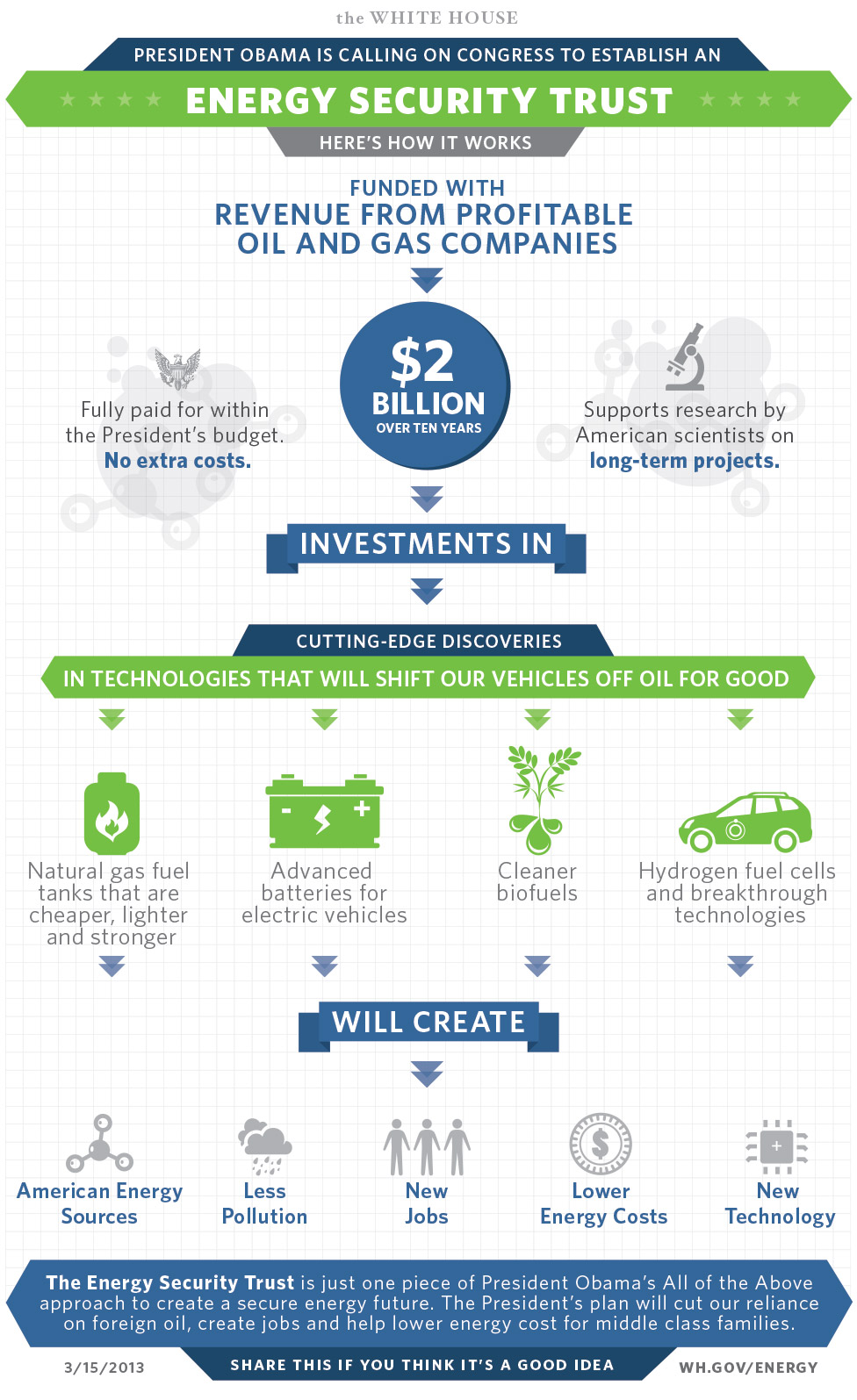
President Obama Proposes $2 billion Energy Security Trust to Fund Alternative Transportation Fuels


President Obama, (See Video Here) while touring the Argonne National Laboratory outside Chicago on Friday, introduced his plan for an Energy Security Trust to accelerate the development of alternative fuels for transportation.  The objective is to reduce the impact on America's families and the economy from high priced and volatile oil.  The plan is designed to be revenue neutral, drawing upon $2 billion of oil and gas offshore gas and oil drilling royalties over ten years, to fund technologies including advanced batteries, biofuels, natural gas fuel tanks, hydrogen fuel cells.

"Over 10 years, the Energy Security Trust will provide $2 billion for critical, cutting-edge research focused on developing cost-effective transportation alternatives.The funding will be provided by revenues from federal oil and gas development, and will not add any additional costs to the federal budget. The investments will support research into a range of technologies – things like advanced vehicles that run on electricity, homegrown biofuels, and domestically produced natural gas. It will also help fund a small number of real-world experiments that try different transportation techniques in cities and towns around the country using advanced vehicles at scale."

Friday, March 15, 2013

Natural Gas Prices Increase 65% in 12 Months

Natural gas prices have been increasing over the past twelve months, rising from a low of below $2 per MMBtu in April, 2012 to over $3.50 per MMBtu this week.

The market is adjusting to key price factors, including:
  1. Continued expansion and increased utilization of natural gas fired power plants creating high demand;
  2. Natural gas fracking requires higher natural gas pricing to support capital investments based on expected returns.  Capital formation for fracking has gone flat due to low natural gas prices;
  3. Plans to export natural gas (LNG) to higher cost European markets creates support for a higher price floor.
For more on the natural gas market, please see the following:


Thursday, March 14, 2013

Smart Grid Company Silver Spring Networks' NASDAQ IPO Raises $81 Million - Shares Surge 29% on First Day of Trading


Smart Grid Company Silver Spring Networks raises $81 million in long awaited IPO, with shares surging 29% on the first day of trading.  This IPO puts the company's valuation at approximately $750 million, and gives the company access to capital markets, an important source of capital to fund the company's operations going forward.  There are a few points to raise regarding this offering:

  1. The company sold 4.75 million shares, up from the 3.75 million shares it had expected to sell as of last week;
  2. None of the existing investors sold their shares in the IPO, preferring to hold onto their investments;
  3. The company has raised approximately $303 million in debt and equity since 2004;
  4. 2012 revenues of $197 million are 17% lower than 2011 revenues of $237;
  5. Silver Spring Networks lost close to $90 million in 2012, a number that has to get smaller very fast, or the company runs the risk of approaching subsequent capital raises just to fund negative margin operations; 
  6. The majority of the company's revenues come from 7 major United States utility customers; and
  7. The boom in smart meter deployments in the United States has subsided.

The basis for the company's valuation and future growth prospects is premised on the following:

  1. Leverage the Installed Base - Silver Spring Networks' deployed smart grid communications networks are platforms for deploying additional products and services up and down the energy value chain, from DSCADA to improve utility grid performance and operation, to leveraging the customer interface for utilities, and into the customer's premise, providing energy management control and data acquisition for customers.  Demand response, for example, represented a very small proportion of hte company's revenues;
  2. Expand Internationally - The opportunity for smart grid deployments and AMI continues to expand internationally, recognizing that Silver Spring Networks already has customer relationships in Australia, Brazil, the UK and Singapore.  International only accounted for an estimated 8% of revenues in 2012. 
  3. Deploy Additional Equipment and Services - Much like Itron, Silver Spring Networks has the opportunity to leverage its stock to acquire additional equipment and software companies to layer additional revenue generating services on top of their smart grid platform.
  4. Expand Into Additional Markets - Silver Spring Networks also has the opportunity to deploy their communications networks and solutions in gas and water industries, as well as selectively targeting other network and industrial businesses that can use their wide area energy management capabilities, perhaps including trains and natural gas pipelines.

At the end of the day, for this IPO to be successful, the Silver Spring Networks has to have a brilliant execution strategy over the next 12 months in order to demonstrate that they can meet the expectations embodied in this first day of trading.  Critical will be (1) turning around the decline in revenues; (2) reducing losses on a quarterly basis to demonstrate being on a pathway to a sustainable cash flow; (3) demonstrating success in expanding into new international markets; and (4) demonstrating their ability to expand products and services to leverage their core network platform.

Wednesday, March 13, 2013

Commercial Fleet Hybrid-Electric Powertrain Company, XL Hybrids, Secures $4 Million In Series B Investment

XL Hybrids, a Fleet Hybrid Conversion company, announced today that they secured $4 million in a Series B investment to fund the growth of their hybrid electric powertrain business. XL Hybrids designed an add-on hybrid-electric solution for commercial fleets to improve their fuel efficiency by 20% or more, without making major modifications to existing OEM vehicles in commercial service. Their add-on solution, seen in the image below, captures and stores energy through regenerative braking.
 
 The XL Hybrids system is designed to work on the most popular Class 1-3 fleet vehicles, including cargo/utility/shuttle vans and pickup trucks. The hybrid drive train is installed either as a retrofit to an existing vehicle, or installed as an upfit onto a new vehicle before delivery. The system is installed through a nationwide network of certified installation partners.

The system consists of a 40 kW Peak Power Permanent Magnet Electric Motor coupled with a 2 kWh Lithium-Ion Battery and Control System, delivering 220 lb-ft of peak torque.

From the company:
PRESS RELEASE

XL Hybrids Secures $4 Million In Series B Investment Financing
Will Support Product Growth Throughout North America
 BOSTON, March 13, 2013 – XL Hybrids, Inc., provider of a low-cost hybrid electric powertrain designed for class 1 to 3 commercial fleet vehicles, today announced that it has raised $4 million in a series B investment round led by private investors, with previous investors also participating in the round. After developing its hybrid powertrain technology and validating it in the field with multiple Fortune 500 companies, XL Hybrids will use this funding to ramp up the delivery of its hybrid electric powertrain to existing and new customers.

Investors in this round include successful entrepreneurs and leading business executives from multiple industries, including automotive, energy, software and finance. While massive government loans and other sources of funding dry up for many cleantech companies, XL Hybrids has proven its ability to deliver fuel savings with a cost-effective technology, sell to large Fortune 500 companies and implement a capital-efficient business model. XL Hybrids’ hybrid electric powertrain reduces fuel consumption by 20 percent and can be installed in both new and existing vehicles. This type of system is ideal for companies operating commercial vans, box-trucks and shuttles in and around major urban markets.

“This round of investment enables us to start scaling our business and expanding our geographic reach. We are working with customers that have large national and international fleets, and we can now help them save fuel and money at a larger scale,” said Tod Hynes, president and founder of XL Hybrids. “With support from our investors, XL Hybrids will continue to expand the availability of our hybrid powertrain and meet the demands of commercial fleets looking for a proven return on investment and reduced emissions.”

This latest investment round brings the total amount of funding for XL Hybrids to approximately $8 million. Earlier this quarter, XL Hybrids expanded its product line to offer hybrid powertrain technology for Ford E-Series vans; the company can now offer a compelling return on investment and significant emissions reductions to more than 75 percent of light duty van fleet buyers. XL Hybrids also signed an installation partnership and distribution agreement with Leggett & Platt Commercial Vehicle Products (CVP), providing its customers with ship-through ordering.

 For more information on XL Hybrids technology and availability, visit www.xlhybrids.comor email info [at] xlhybrids.com.

 About XL Hybrids
 XL Hybrids designs, manufactures and installs hybrid electric powertrains for commercial vans and trucks. The company’s patent-pending hybrid electric powertrain can be installed on existing vehicles or as an upfit on new ones. By storing energy wasted in braking and reapplying it during acceleration, XL Hybrids technology decreases fuel use and carbon dioxide emissions by up to 21.2 percent on urban routes, while operating with the same durability and reliability as traditional vans and trucks. XL Hybrids was founded by MIT alumni and is based in Boston. For more information, visit www.xlhybrids.com.

Tuesday, February 19, 2013

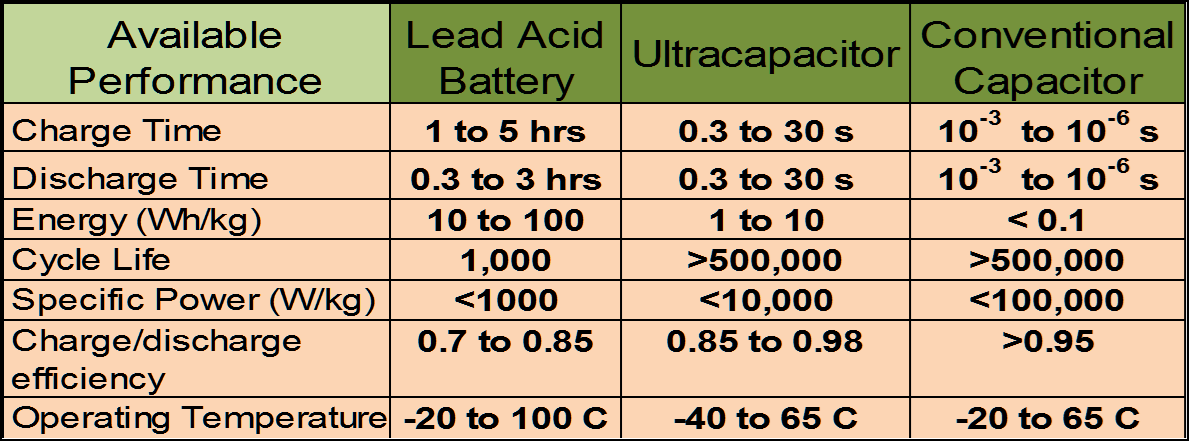
Capacitors versus Batteries

Here is a chart comparing batteries with capacitors: Source: www.tecategroup.com

Monday, February 18, 2013

Alberta's Energy Boom and Revenues Subsiding

Alberta, Canada's primary energy production is heavily weighed towards natural gas, representing approximately 80% of the energy content of oil and natural gas produced. From 2006 to 2010, natural gas production declined 21%, due to North American natural gas price declines due to increased supply in the lower forty-eight with the fracking boom. The graph below is from Alberta's Natural Gas Industry Quarterly Update, Summer 2012: http://www.albertacanada.com/files/albertacanada/NGas_QuarterlyUpdate_Summer2012.pdf It shows the precipitous decline in Alberta's natural gas exports.